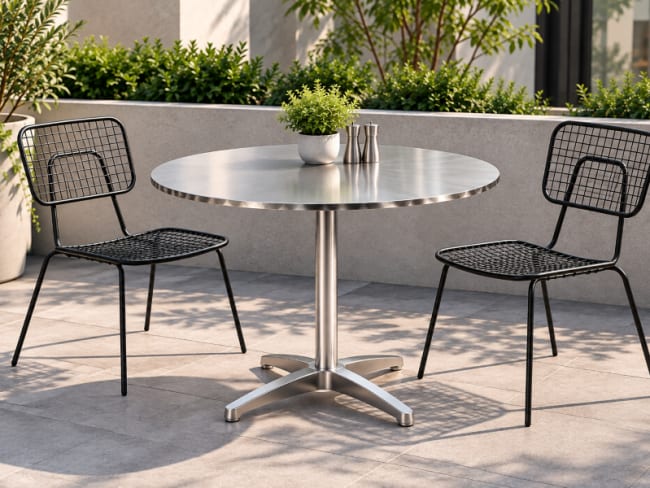
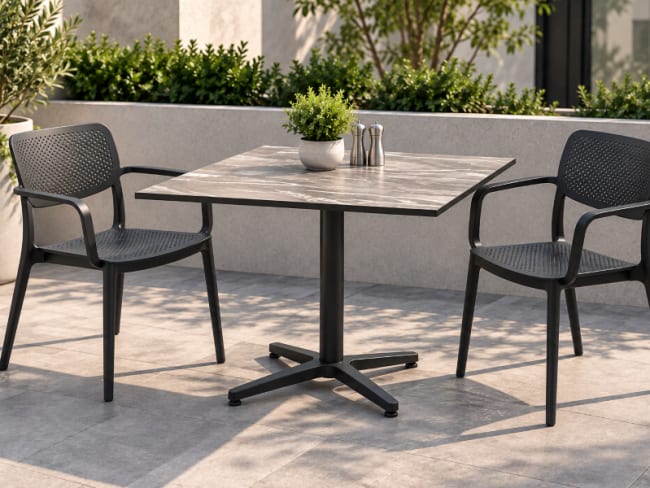
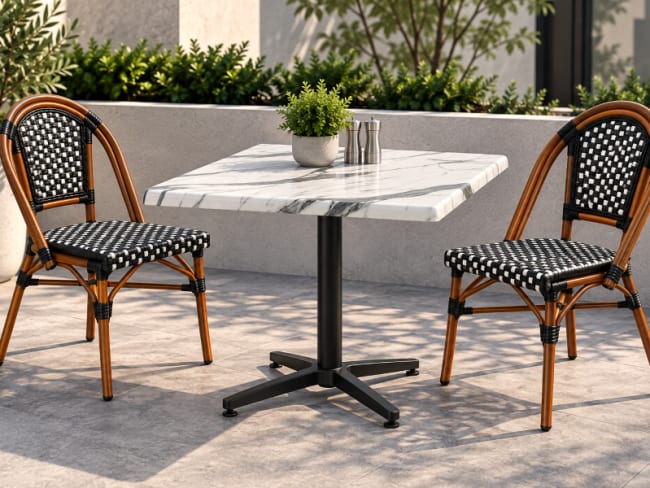
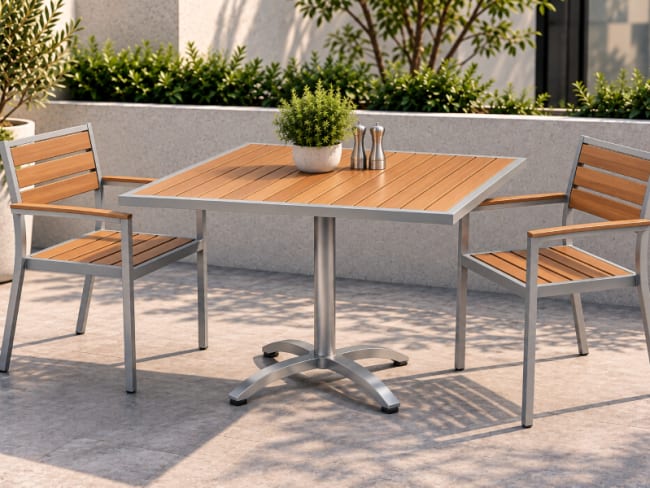
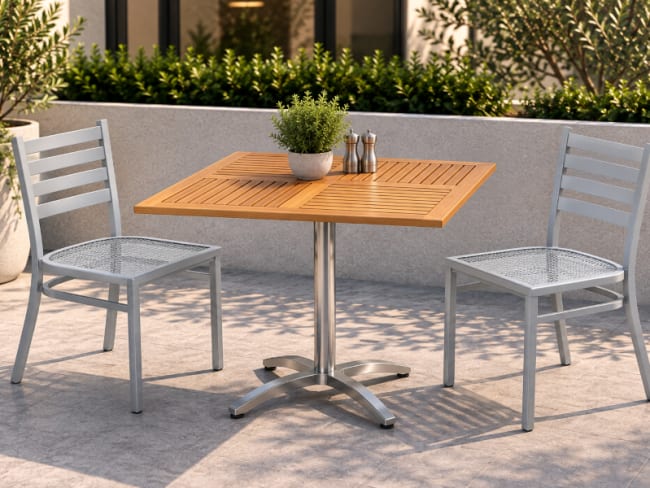
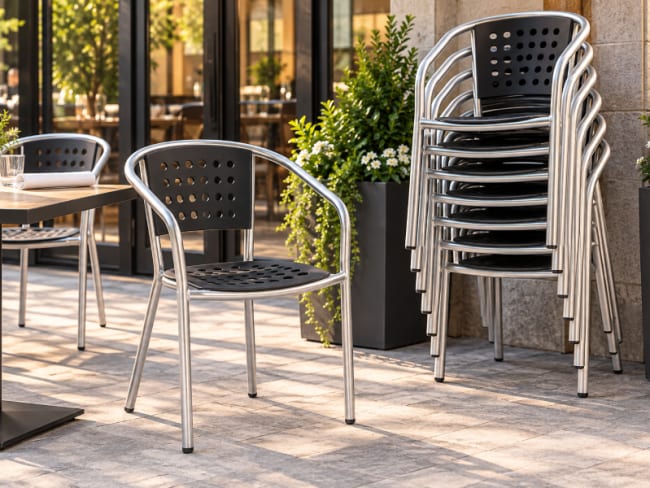
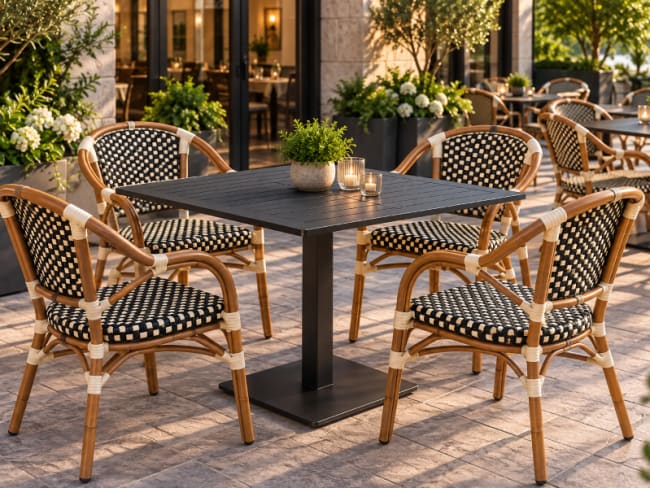
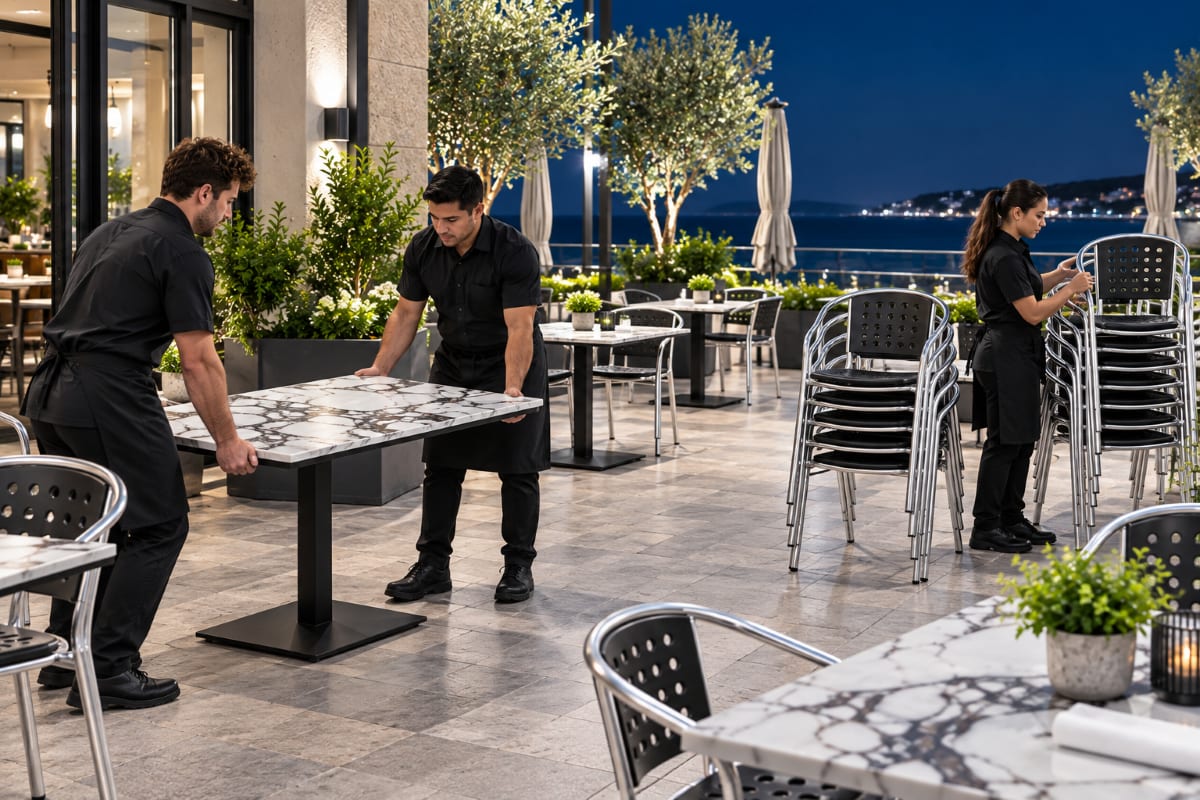
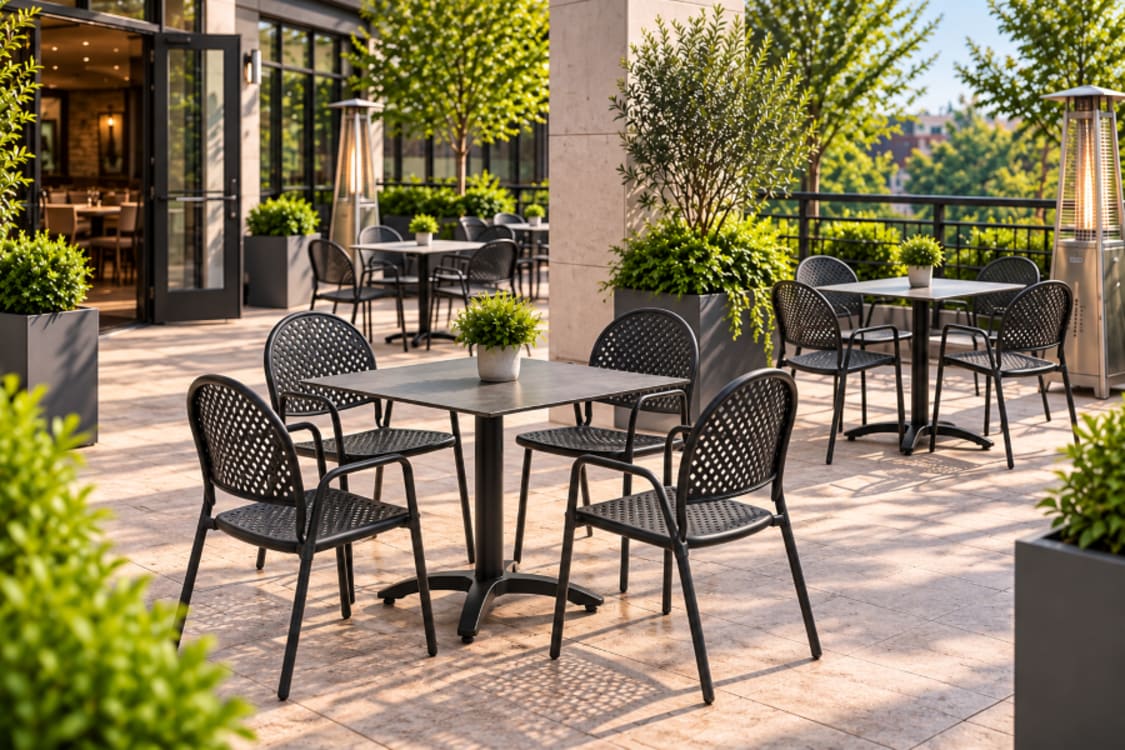
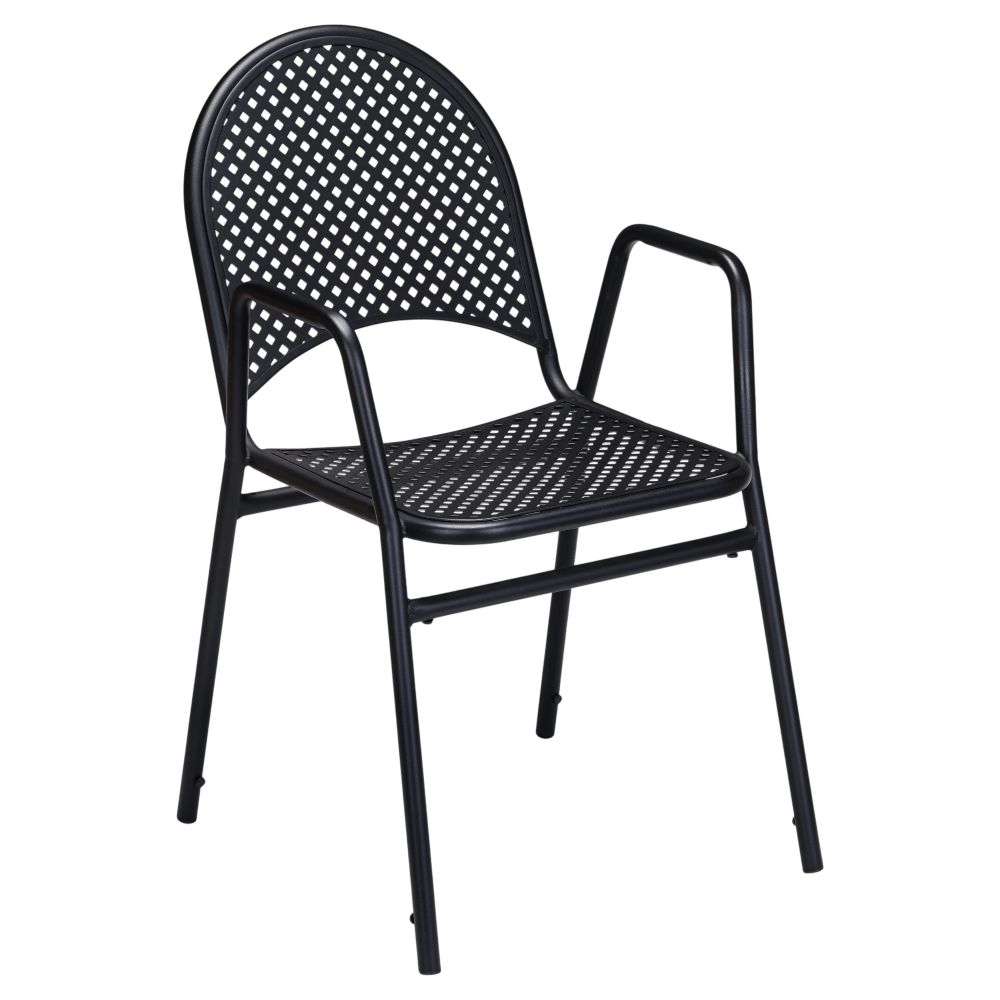
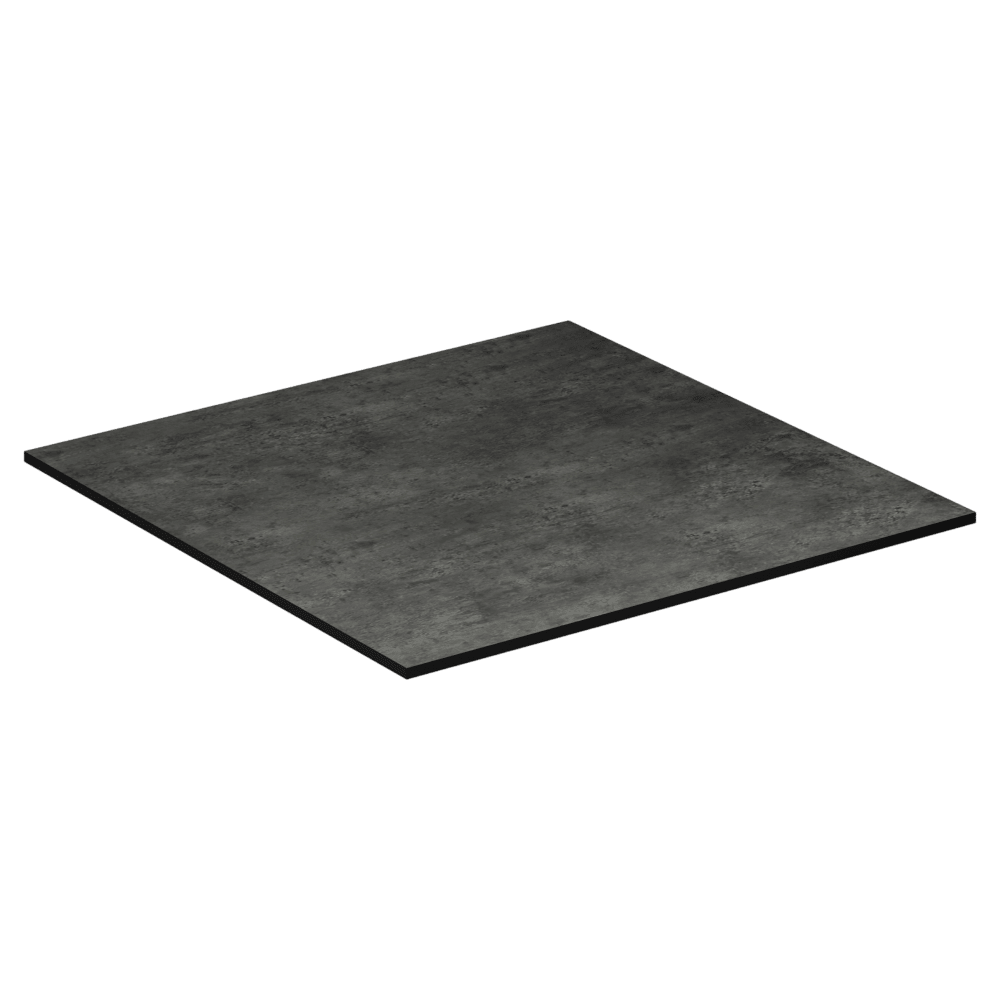
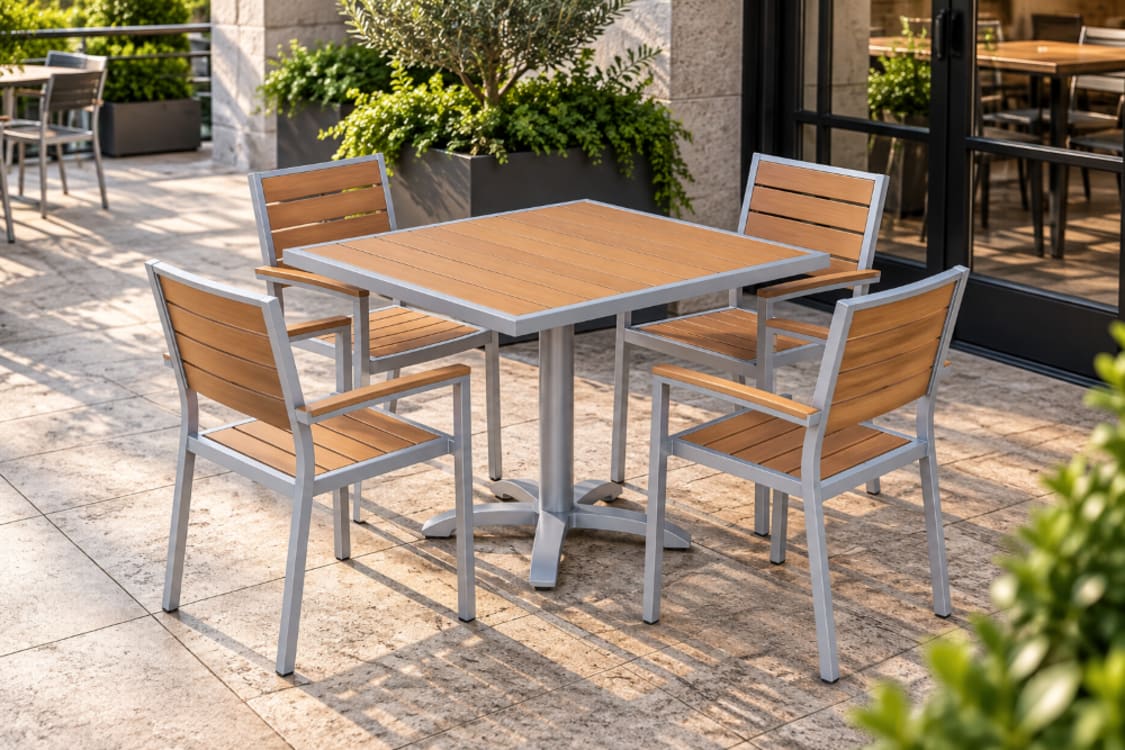
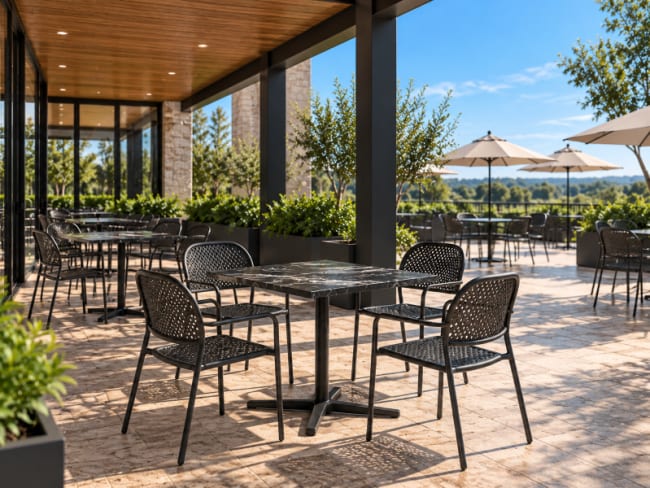
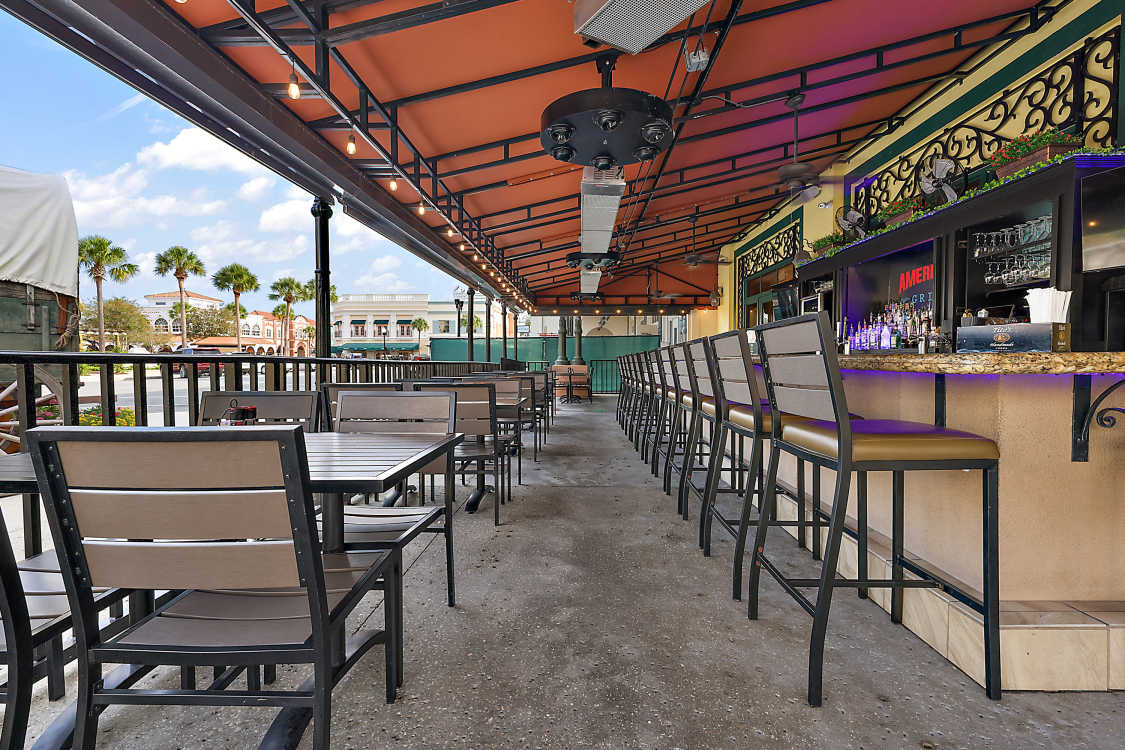
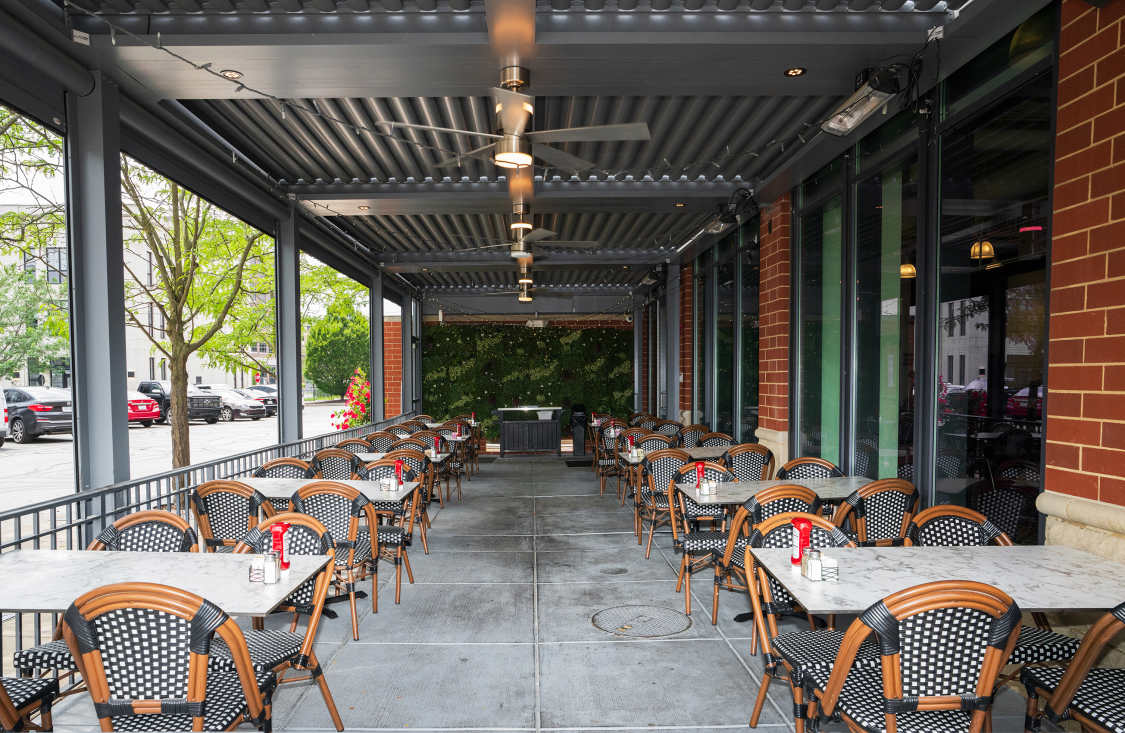
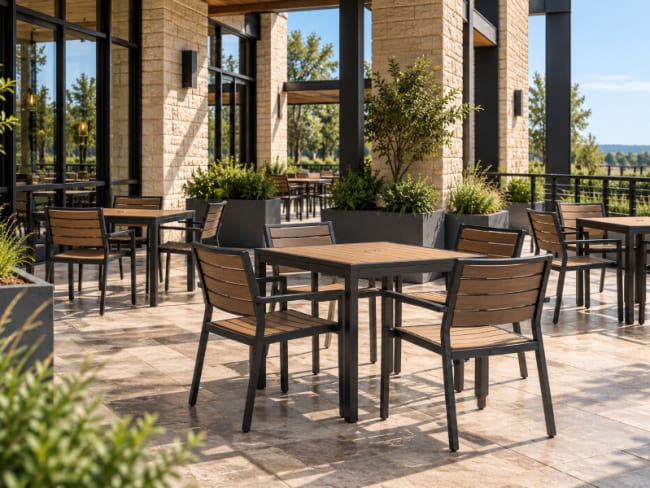
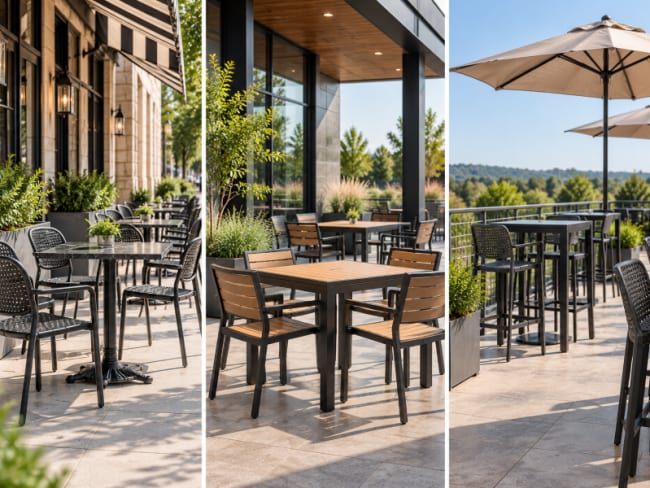
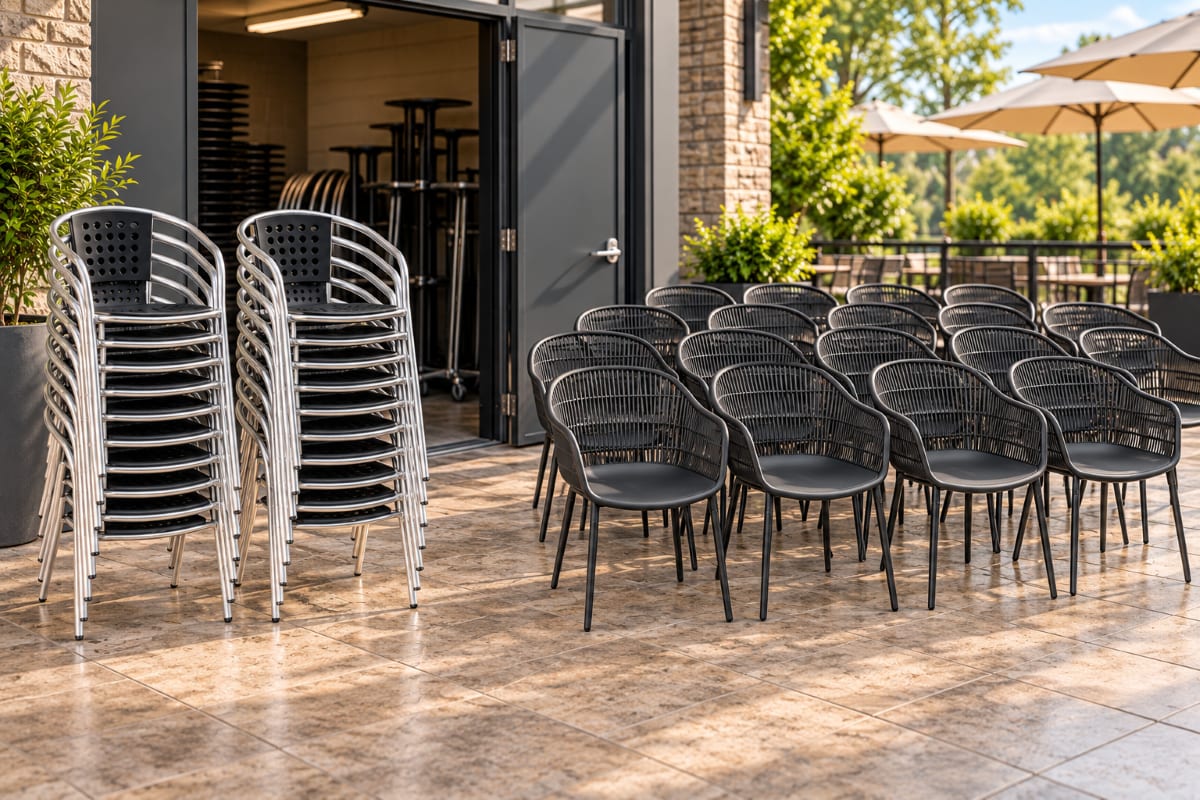
Restaurant patio furniture has to withstand repeated commercial use, frequent cleaning, and the daily movement that comes with restaurant service while also handling outdoor conditions such as sun, moisture, temperature changes, and wind. The level of protection the patio provides, along with its surface, available storage, and service style, can all affect which furniture works best.
This guide explains how to evaluate your patio, compare outdoor furniture materials, choose commercial chairs, bar stools, tables, and bases, and plan furniture around the usable space. It also covers shade, weather protection, storage, cleaning, and ongoing care so you can choose patio furniture that fits both the restaurant and the conditions where it will be used.
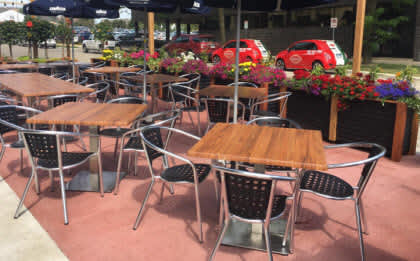
Before choosing tables and chairs, walk through how the patio works during a normal day. Look at the surface under the furniture, how much the arrangement changes during service, where everything goes after closing, and how guests will use the space. These conditions help establish which furniture characteristics will matter most once the patio is in service.
Outdoor conditions belong in that assessment as well. A covered courtyard and an open rooftop experience different amounts of sun, rain, and wind, but exposure alone does not tell you which patio furniture to buy. It is one part of understanding the space and how the furniture will be used there.
Start With the Surface
What's under the furniture?
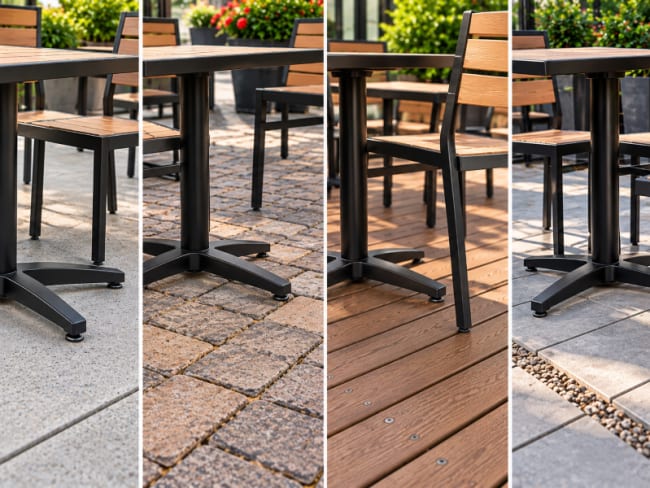
Concrete, pavers, decking, and other patio surfaces affect how tables and chairs sit and move. Drainage slopes, joints, gaps, grates, and small changes in elevation may be easy to overlook on an empty patio but can interfere with chair feet or table bases once the space is furnished.
Pay particular attention to where tables will sit. A slight slope or uneven section may be barely noticeable underfoot but obvious when a table rocks during a meal. Adjustable glides can help with minor variations, but first walk the seating area and identify where furniture will actually rest.
Plan for Moving and Storage
What happens after service?
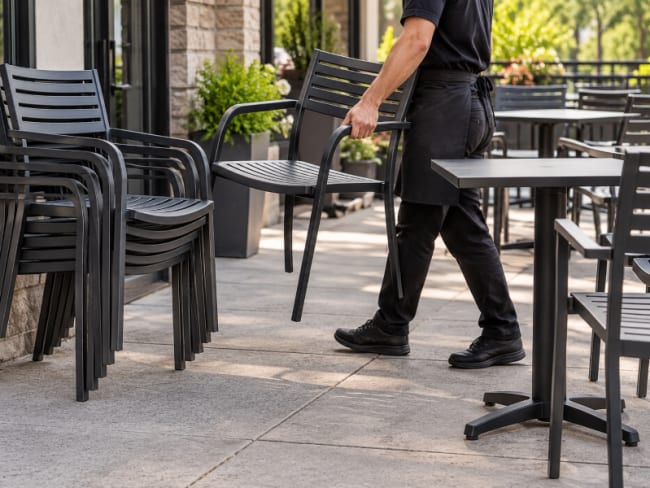
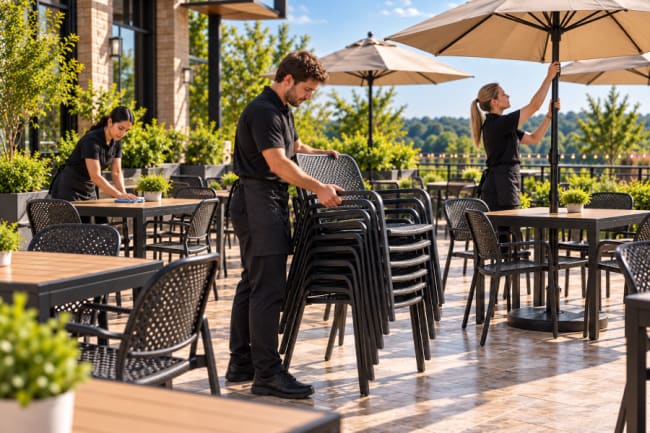
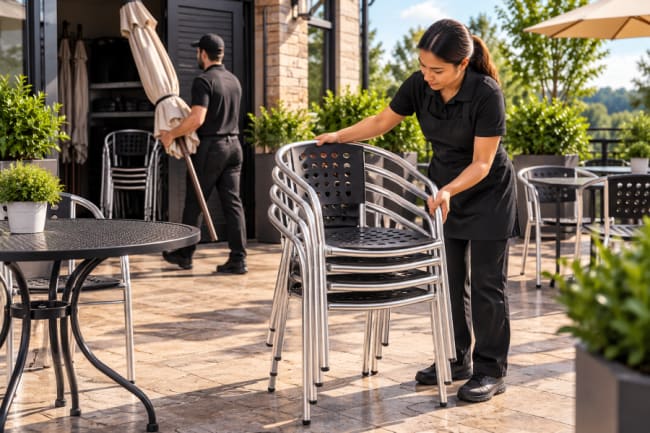
Some patios stay furnished throughout the season. Others are cleared nightly, rearranged regularly, or stored when outdoor service ends. If staff move furniture frequently, weight and ease of handling become practical concerns rather than specifications on a product page.
Stackable chairs can reduce trips and storage space, while easily moved tables make changing party configurations less cumbersome. Before ordering, consider how often the patio will be reset and where the furniture goes afterward. That routine will tell you how much weight, stackability, and mobility should influence the products you choose.
Match the Furniture to the Service
How will guests use it?
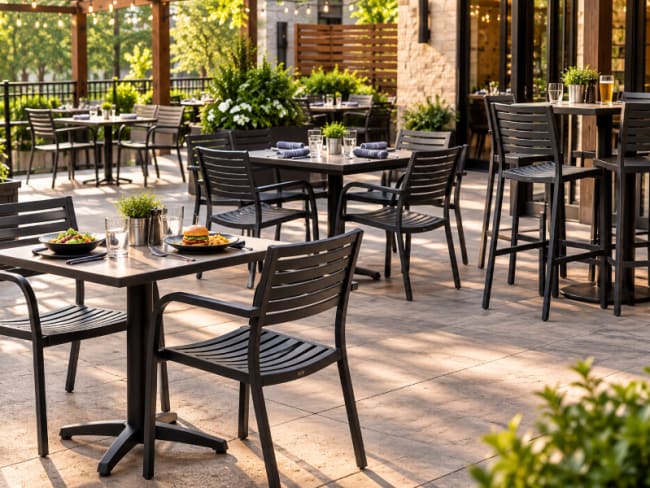
A patio serving full meals asks something different of its furniture than one centered on drinks or shorter visits. Longer meals place more emphasis on comfortable seating and usable tabletop space, while bar service may call for bar-height furniture and faster-service restaurants may benefit from smaller, easily reset tables.
Consider typical party sizes and how often arrangements change. Two-tops use limited space efficiently and can often combine for larger groups. Before planning the complete layout, establish what guests will eat and drink, how long they typically stay, usual party sizes, and how frequently the furniture needs to move.
Account for Outdoor Conditions
Sun, rain, wind, temperature changes, and local conditions such as coastal salt exposure are part of operating an outdoor dining area. How much the patio encounters depends on its location and architecture. A permanent roof or awning can reduce direct exposure, while an open terrace or rooftop may receive sun, precipitation, and wind throughout the day.
Take note of where those conditions are strongest. Wind may affect how easily lightweight furniture moves and will also matter when umbrellas are added to the layout. Regular exposure can influence cleaning and care routines, while seasonal weather may determine when furniture needs to be stored. Product care instructions and any manufacturer restrictions should be checked before the furniture goes into service.
✓
Design Takeaway
Walk the Patio Before You Fill It
An empty patio can hide problems that become obvious once tables and chairs are in place. Walk the areas where furniture will actually sit, check the surface, think through how staff will move and store each piece, and picture the space during a typical meal period. A few minutes spent doing that can reveal which furniture features will matter every day.
Restaurant patio furniture has to meet the demands of commercial service and the conditions of outdoor use. A product may be suited to one without necessarily being suited to the other.
Understanding that distinction makes it easier to compare indoor commercial furniture, residential outdoor furniture, and furniture intended specifically for commercial outdoor settings.
Commercial Grade and Outdoor Rated Are Different Requirements
“Commercial grade” generally describes furniture intended for repeated use in a business or hospitality setting. “Outdoor rated” or “suitable for outdoor use” addresses a different requirement: whether the complete product is intended for conditions such as moisture, sunlight, temperature changes, and other environmental exposure.
Furniture can satisfy one requirement without satisfying the other. A commercial dining chair may be perfectly appropriate for a busy indoor dining room but use materials or finishes that were never intended for outdoor exposure. Residential patio furniture may be designed to live outdoors but may not be built for the frequency of use and handling expected in a restaurant.
For a restaurant patio, look for furniture intended for both commercial and outdoor use.
|
Furniture Type
|
Built Around
|
What It Does Not Establish
|
|
Commercial Indoor Furniture
|
Built Around
Frequent use, cleaning and handling in commercial interiors
|
What It Does Not Establish
Suitability for outdoor exposure
|
|
Residential Outdoor Furniture
|
Built Around
Outdoor conditions and residential use
|
What It Does Not Establish
Suitability for restaurant traffic and commercial service
|
|
Commercial Outdoor Furniture
|
Built Around
Commercial use combined with outdoor conditions
|
What It Does Not Establish
Suitability for every location or use without checking the individual product specifications
|
Read the Product Specifications Before You Buy
Before ordering, confirm that the furniture is intended for commercial outdoor use. Do not assume that a material such as aluminum, resin, or an outdoor-rated tabletop establishes the suitability of the finished product. This is particularly important when table tops and bases are selected separately.
Check the specifications that affect how the furniture will actually be used. Depending on the product, these may include weight capacity, stacking limits, compatible table top sizes or bases, care requirements, and other manufacturer restrictions. Review the warranty for use or maintenance conditions as well, and keep the manufacturer's care instructions available for staff after purchase.
For a more detailed look at residential vs. commercial furniture, please see our Residential vs. Commercial Furniture Guide.
✓
Design Takeaway
Verify the Intended Use
Confirm that the finished furniture is intended for commercial outdoor use, then check the specifications and care requirements that apply to the individual product.
Once you know how the patio will be used, materials are much easier to compare. Weight, cleaning, appearance, construction, maintenance, and the amount of handling the furniture receives can all affect how well a material fits the restaurant.
Material names are a useful starting point, but products within the same category can differ in construction, finish, weight, care requirements, and exposure limits. Use the comparisons below to narrow the choices, then check the specifications and care instructions for the individual product before ordering.
Lightweight, movable and corrosion resistant
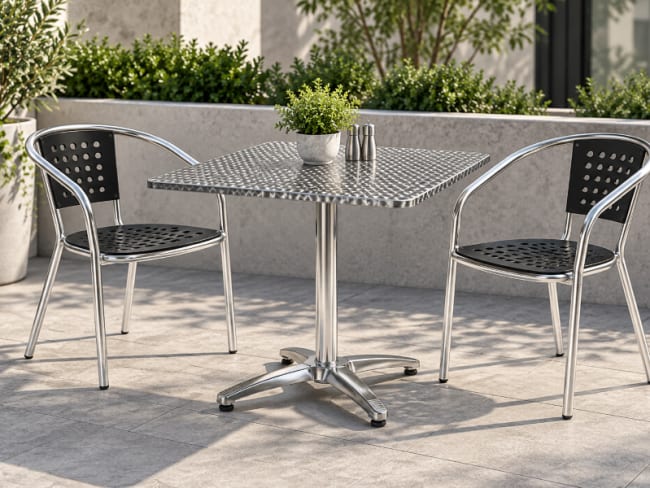
Aluminum is widely used for commercial patio chairs, bar stools, tables, and bases. It does not rust like ordinary steel, although oxidation and finish damage can still occur. Powder-coated finishes are common and add color and surface protection. Aluminum furniture is generally lighter than comparable steel furniture, making it easier to move, rearrange, and store. That lower weight is useful for frequent patio resets, but it also deserves consideration where wind is a recurring concern.
More weight with different corrosion considerations
Steel is generally heavier than aluminum in comparable furniture designs, which can make it harder to move but useful where unwanted movement is a concern. Because exposed ordinary steel can rust, protective finishes and proper care are particularly important outdoors. Stainless steel, ordinary steel, and aluminum should not be treated as interchangeable because their corrosion characteristics, weight, finishes, and maintenance needs differ. Identify the actual metal used rather than relying on a broad description such as metal patio furniture.
Lightweight construction in many forms
Commercial resin furniture comes in solid, perforated, slatted, textured, and open-pattern designs. Many resin chairs are relatively lightweight and stackable, making them practical for patios that are cleared or rearranged frequently. Construction and surface design affect maintenance as well. Smooth molded surfaces present a different cleaning job than perforated or deeply textured designs. Resin formulations also vary, including their response to outdoor exposure, so UV resistance and other stated performance characteristics should be compared between products.
Similar appearance, different construction
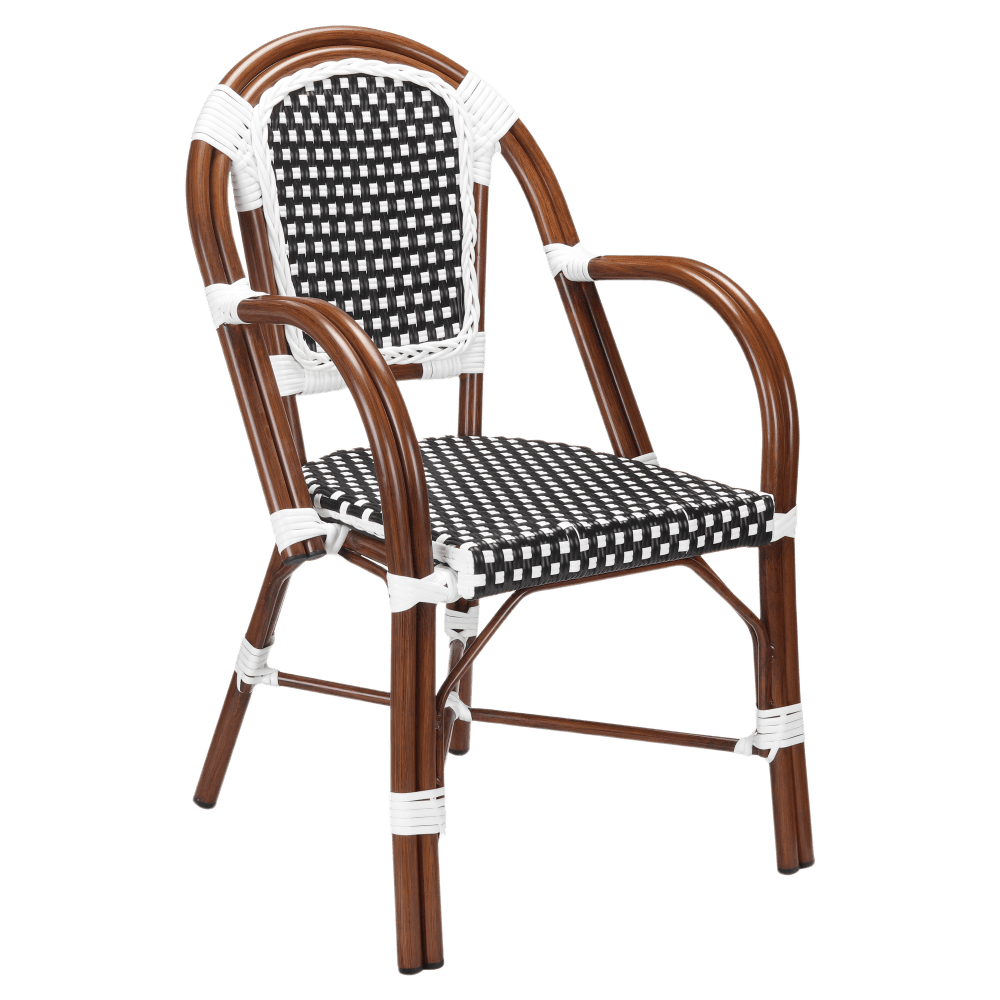
A woven appearance does not always mean woven construction. Some patio chairs use synthetic wicker or faux rattan over a separate frame, while others mold a similar pattern directly into resin. With woven furniture, both the weave and supporting frame matter, and debris can collect between strands. Molded wicker-look resin eliminates the separate weave but may still have textured areas that require cleaning. Identify the actual construction before comparing products that look similar.
Wood appearance without natural wood
Synthetic teak, poly, and other wood-look materials provide the appearance of wood without necessarily using natural wood for the exposed surface. Construction varies considerably. Some products use synthetic slats over an aluminum frame, while others use different molded or composite constructions. Similar appearances therefore do not guarantee similar weight, maintenance, or exposure characteristics. Identify what the wood-look components are actually made from and how they are supported before comparing products.
Natural character with changing appearance
Natural wood can work well outdoors when the species, construction, finish, and intended use suit the setting. Unlike molded synthetics or metal, wood may change color or surface appearance as it encounters sunlight, moisture, and changing temperatures. Some products require periodic oiling, refinishing, or other maintenance to preserve their original appearance, while others are allowed to weather naturally. Check what appearance changes to expect and what maintenance is required before choosing natural wood for a restaurant patio.
Outdoor Tabletop Materials
Outdoor tabletops deserve separate consideration because the top and base may be selected independently. Patio-rated options can include synthetic wood-look constructions, resin or composite surfaces, metal, natural wood, and other materials specifically made for outdoor use.
Compare the actual surface and construction, including weight, cleaning requirements, edge or slat design, and mounting needs. Slatted tops, for example, allow water and debris to pass between the slats, while natural wood may require finish maintenance. Verify that the specific top is intended for outdoor commercial use and is compatible with the selected outdoor base.
Commercial Patio Furniture Materials Compared
|
Material
|
Weather / Exposure Considerations
|
Relative Weight
|
Routine Care
|
Common Furniture Types
|
Best Reason to Consider It
|
|
Aluminum
|
Weather / Exposure Considerations
Does not rust like ordinary steel; finish and construction still require care
|
Relative Weight
Generally lighter
|
Routine Care
Clean finish and inspect for damage
|
Common Furniture Types
Chairs, bar stools, tables, bases
|
Best Reason to Consider It
Easy handling with broad commercial patio use
|
|
Outdoor Steel
|
Weather / Exposure Considerations
Protective finish helps prevent corrosion; damaged areas need attention
|
Relative Weight
Generally heavier
|
Routine Care
Clean and inspect protective finish
|
Common Furniture Types
Chairs, bar stools, tables, bases
|
Best Reason to Consider It
Added weight and strong frame construction
|
|
Molded Resin / Synthetics
|
Weather / Exposure Considerations
Moisture resistant; UV performance depends on the specific material
|
Relative Weight
Generally light to moderate
|
Routine Care
Usually straightforward surface cleaning
|
Common Furniture Types
Chairs, stools, some tables
|
Best Reason to Consider It
Easy cleaning and molded design options
|
|
Synthetic Wicker / Faux Rattan
|
Weather / Exposure Considerations
Check both the weave and supporting frame for outdoor suitability
|
Relative Weight
Varies by frame
|
Routine Care
Clean between and beneath woven surfaces
|
Common Furniture Types
Chairs, armchairs, some stools
|
Best Reason to Consider It
Woven appearance with synthetic outdoor materials
|
|
Synthetic Teak / Poly / Wood-Look Materials
|
Weather / Exposure Considerations
Exposure performance depends on the specific material and construction
|
Relative Weight
Varies
|
Routine Care
Follow product-specific cleaning instructions
|
Common Furniture Types
Chairs, bar stools, tables, tabletops
|
Best Reason to Consider It
Wood-like appearance using synthetic outdoor materials
|
|
Outdoor-Rated Natural Wood
|
Weather / Exposure Considerations
Species, finish and product specifications determine outdoor suitability
|
Relative Weight
Varies
|
Routine Care
May require periodic finish or appearance maintenance
|
Common Furniture Types
Chairs, tables, tabletops
|
Best Reason to Consider It
Natural grain, color and material character
|
|
Exterior-Rated Tabletop Materials
|
Weather / Exposure Considerations
Depends on the specific top construction and material
|
Relative Weight
Varies
|
Routine Care
Follow instructions for the specific surface
|
Common Furniture Types
Tabletops and complete tables
|
Best Reason to Consider It
Allows the dining surface to be selected separately from the base
|
✓
Design Takeaway
Compare the Material and the Finished Furniture
Material is a useful starting point, but two chairs made from the same general material can differ in weight, construction, finish, hardware, stackability, and care requirements. Use the material to narrow the choices, then compare the specifications of the complete products that fit the way your patio is used.
Patio seating has to work for guests while standing up to outdoor conditions and the way staff handle the furniture every day. Once you have narrowed the choices of patio chairs and bar stools, focus on the characteristics that become particularly important outside.
Think about whether chairs will stay outdoors, come inside after service, move frequently for different party sizes, or go into seasonal storage. Weight, stackability, drainage, drying, and ease of cleaning can have a noticeable effect when those routines are repeated across an entire patio.
Stackable or Non-Stackable Patio Chairs?
Stackability is useful when chairs actually need to be moved or stored. Restaurants that clear their patios nightly, change seating configurations frequently, or put furniture into seasonal storage can reduce the amount of storage space required by choosing chairs designed to stack.
The benefit becomes more important as chair quantity increases. If stackability matters to the restaurant, check the product specifications and any stated stacking limit rather than judging from the chair's shape.
Stackable Makes Sense When
Chairs come inside after service, seating configurations change frequently, or seasonal storage is required. Stacking can also make better use of limited storage space when dozens of chairs need to be put away at once.
Non-Stackable Makes Sense When
Seating remains largely in place and storage is not a regular concern. In that situation, stackability does not need to outweigh another chair's advantages in comfort, construction, appearance, or suitability for the patio.
Consider Weight Across the Whole Patio
There is no universal ideal weight for patio seating. Lighter chairs are easier for staff to carry, reset, and store. That difference becomes noticeable when an entire patio has to be moved rather than a single chair.
Additional weight can help reduce unwanted movement, but staff still have to handle that weight whenever chairs are rearranged, cleaned around, or put into storage. Wind conditions also vary by patio, so weight should be considered alongside the conditions of the actual space.
Compare actual product weights when available instead of relying on material alone. Two chairs made from the same general material can still be noticeably different to handle, so consider the balance between easy movement and unwanted movement when comparing options.
Consider Drainage and Cleaning
Outdoor seating has to deal with more than spills and crumbs. Rain, leaves, dirt, and other outdoor debris can affect how quickly chairs can be cleaned and returned to service, and the construction of the chair plays a large part in what that routine requires.
Slats, perforations, and open-weave surfaces can allow water to drain, while other designs may hold water and require more drying or wiping. Those same openings and textured surfaces can create places for debris to collect, so look at where water goes, where dirt is likely to settle, and whether staff can easily reach those areas during routine cleaning.
1
After the Rain
Where Does the Water Go?
Check whether the seat allows water to drain or is likely
to require wiping or additional drying time.
2
After the Rain
Where Will Debris Collect?
Look at woven strands, textured surfaces, narrow gaps, and
other areas where crumbs, leaves, and dirt can settle.
3
After the Rain
Can Staff Reach It?
Consider whether those areas can be reached easily when
staff are cleaning an entire patio rather than one chair.
4
After the Rain
Are Drainage Openings Clear?
Drainage openings and gaps need to remain clear. Dirt and
debris can block small openings and leave water sitting
where it would normally drain away.
Don't Lose Sight of Guest Comfort
Patio seating still needs to be comfortable for the restaurant's typical style of service and length of stay. Because outdoor chairs are often unpadded, the shape and support of the chair itself can become more noticeable during longer meals.
Guest comfort should be evaluated alongside the practical requirements of outdoor seating, including furniture weight, drainage, cleaning, and storage. A chair may feel good at the table but still be a poor fit for the patio if it is unnecessarily difficult to move, clean, dry, or store.
When possible, evaluate the actual chair before ordering in quantity.
✓
Design Takeaway
Choose Seating for the Whole Shift
Consider what happens to patio seating throughout the day. Guests need chairs that suit the dining experience, while staff need furniture they can reasonably move, clean, dry, reset, and store. Choose seating that works for both parts of that routine.
Patio tables follow many of the same basic selection rules as indoor restaurant tables, so there is no need to repeat those decisions here. For more detail on table sizes, shapes, heights, tops, bases, and general table selection, see our Restaurant Tables and Bases Guide .
For outdoor dining, focus on the conditions that change how the finished table performs on the patio, particularly the surface beneath it and the amount of routine handling it will receive. Consider how the complete table will sit, move, and function in the actual space.
Consider the Patio Surface and Table Base
Use the surface conditions identified earlier in the planning process to evaluate the complete table and base. Look at the base footprint, how its feet or contact points meet the patio, and whether the table provides adjustment for minor variations.
A base that sits securely on one surface may be less practical where its footprint regularly encounters joints, gaps, drainage slopes, or changes in elevation. Compare the finished table against the places it will actually stand rather than evaluating the base by itself.
Consider How Often the Tables Will Move
Some patio tables stay in place throughout the season, while others are routinely shifted as seating configurations change, the patio is cleaned, or furniture is cleared at the end of service. That operating pattern should be part of the buying decision because the same table can be perfectly practical in a fixed layout and inconvenient in a space that changes constantly.
Look at how the patio actually functions over the course of a day. If tables are regularly repositioned or brought in overnight, the ease of handling the complete table matters just as much as its appearance, size, or material.
Heavier tabletop and base combinations deserve additional planning. Stone tops, substantial metal tables, and heavier base configurations may require two employees to move safely, especially when the route includes doors, narrow storage areas, or changes in elevation.
Before ordering in quantity, consider the path the furniture will travel and the labor required to move it. A table that works well in place can still create an operational problem if every reset, closing routine, or seasonal move becomes a two-person task.
✓
Design Takeaway
Plan for How the Table Will Be Used Outdoors
Consider how the complete table will function in the restaurant's daily routine. Table weight becomes especially important when furniture is regularly rearranged, cleared for cleaning, brought inside after service, or moved into seasonal storage. Think about how often those tasks occur and what handling the full patio will require before ordering in quantity.
Once the tables and seating have been narrowed down, the patio can be planned around the furniture that will actually occupy it. Fixed features, furniture footprints, occupied seating, and the routes people need during service all affect how much of the patio can function as dining space.
Start with the usable area, then place complete dining positions within it. The sections below show how to account for fixed obstructions, occupied furniture, service movement, and a practical mix of table sizes.
Measure the Usable Patio, Not Just the Property Line
Start with the space furniture can actually occupy
The outside dimensions tell you how much patio exists. They do not tell you how much of it can be furnished.
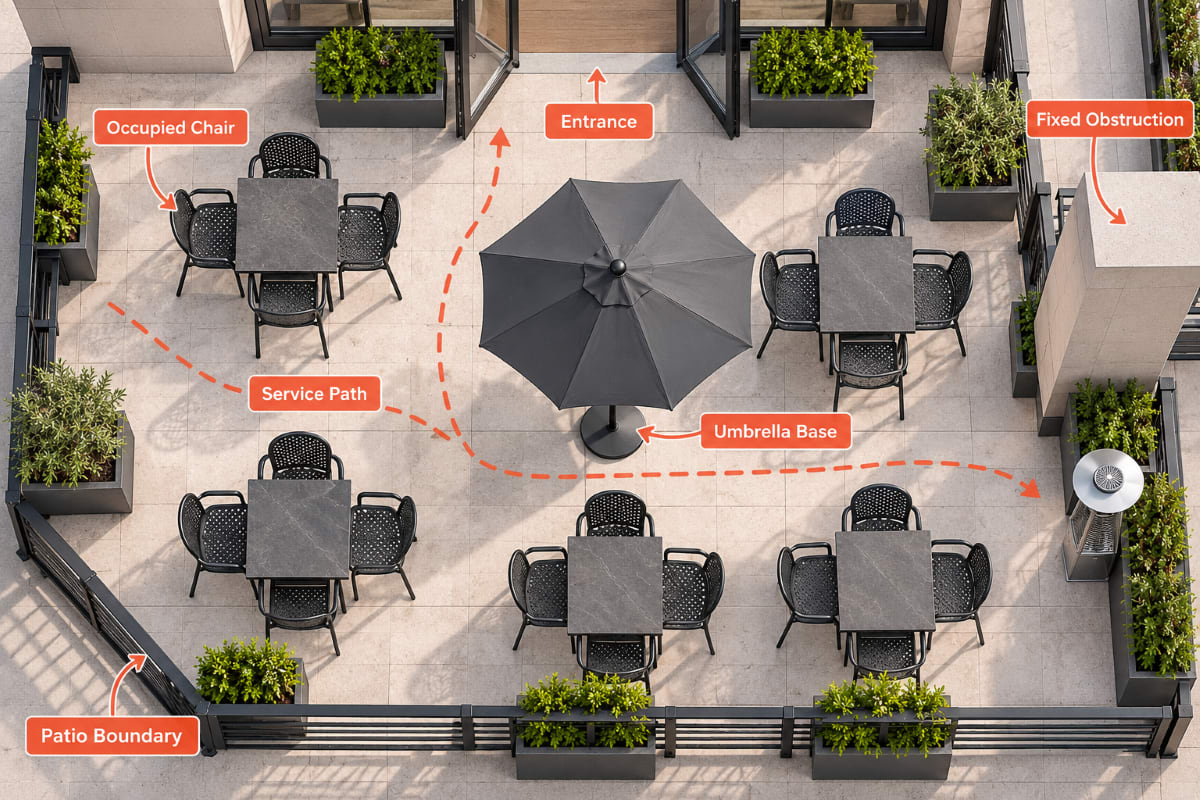
Walk the perimeter and identify the areas furniture cannot occupy. Keep entrances and gates usable, and account for railings, columns, planters, building projections, service equipment, and other fixed obstructions. Umbrella bases also consume floor area even though most of the umbrella is overhead.
Existing heaters or other equipment can affect furniture placement where they are already part of the patio, even if they are not part of the furniture package itself.
Sketch those conditions before placing tables. What remains is a much more useful starting point for the furniture plan.
Calculate the Occupied Furniture Footprint
A 30” table does not occupy 30” of patio
Table dimensions describe the tabletop. The complete dining position includes the chairs around it, and those chairs extend beyond the table edge before a guest ever sits down.
Occupied chairs usually extend farther. Guests also need enough room to approach the chair, sit down, and leave the table. That makes the real footprint of a dining position larger than the dimensions shown for the tabletop alone.
Plan with the table and chairs together. A layout based only on top dimensions can appear roomy on paper and become much tighter as soon as the patio is furnished and occupied.
Preserve Service Paths and Plan a Useful Seating Mix
Balance seating capacity with movement and flexibility
More tables do not automatically create a more useful patio. Servers still need to reach each dining position when chairs are occupied, and guests need a practical way to move between their table, the entrance, and other parts of the restaurant.
Test those paths with the chairs in realistic positions rather than pushed tightly beneath the tables. Then look at the seating mix. Two-tops can handle smaller parties without tying up a four-top, while four-tops and combinable tables provide options for larger groups. Bar seating can add another format where the patio and service style support it.
The strongest layout is not necessarily the one with the largest theoretical seat count. Those seats still have to work during service.
Account for Accessibility and Local Requirements
A patio layout also has to account for the accessibility requirements that apply to the restaurant. Accessible routes, entrances and gates, seating, changes in level, and furniture placement can all affect how much of the patio is available for dining. Outdoor areas may also be subject to local requirements involving sidewalks, public rights-of-way, property boundaries, emergency access, and other site-specific conditions.
Do not assume an arrangement meets applicable requirements simply because guests and staff can physically move between the tables. Requirements vary by property and jurisdiction, so confirm what applies to the restaurant before finalizing the furniture layout.
For a closer look at restaurant accessibility and furniture-planning considerations, see our ADA Restaurant Compliance Guide.
What Actually Uses Patio Space?
A useful patio plan shows more than tables. It shows the complete dining positions, the things that cannot move, and the space that has to remain available around them.
The diagram below brings those elements together in one view.
How Much Space Do Restaurant Patio Tables and Chairs Need?
Plan restaurant patio tables and chairs as complete occupied dining positions. Include occupied chairs, table and umbrella bases, fixed obstructions, entrances and gates, and the paths guests and staff need during service.
Measure the usable patio first, then evaluate capacity with the furniture positioned as it will actually be used.
✓
Design Takeaway
Plan With the Chairs Pulled Out
Test the finished layout under service conditions. Pull chairs into occupied positions, check the routes guests and staff will use, and make sure fixed features and umbrella supports are represented before settling on the final table count.
Shade affects more than guest comfort. Umbrellas and other shade systems interact with occupied seating, tables, floor space, wind exposure, and the way the patio changes throughout the day.
Plan those relationships before selecting the umbrella itself, then compare canopy coverage, construction, support systems, and the conditions in which the shade equipment will be used.
Plan Shade With the Furniture
Start with the dining area that needs protection
Start with the complete dining position rather than the tabletop. Guests and occupied chairs extend beyond the table edge, so compare canopy coverage with the area people actually use. A center-pole umbrella also occupies space through the table and at floor level where its support sits.
Sun angles change throughout the day, which means the area beneath a canopy is not necessarily the area receiving useful shade at every service period. Check when direct sun reaches the patio, which dining positions receive the greatest exposure, and how buildings, awnings, trees, or other permanent cover change those conditions.
Compare Commercial Patio Umbrellas
Look beyond canopy color and size
Commercial patio umbrellas vary in canopy size, frame construction, pole and rib materials, lift mechanism, and fabric. These differences affect how an umbrella fits the dining area and how it will be opened, closed, moved, and stored during regular restaurant use.
Compare the complete specifications rather than choosing from canopy dimensions alone. Pole dimensions, overall height, opening mechanism, frame construction, and compatible support options can all affect whether an umbrella works with the intended table and patio setup.
Outdoor conditions should be part of that comparison. Wind exposure, precipitation, direct sun, storage practices, and manufacturer instructions can affect how and when an umbrella should be used. Check the requirements of the individual product before ordering.
Match the Umbrella to Its Support
Follow the center pole all the way to the base
A center-pole umbrella needs a support system appropriate for the umbrella and the way it will be used. Depending on the configuration, the support may sit beneath a table or operate as a separate umbrella base.
Look at the complete setup before ordering. The pole has to work with the table when it passes through one, and the support below has to fit within the available floor area without creating unnecessary conflicts with chair positions or guest space.
Base weight, footprint, mobility, and compatible pole dimensions can differ by product. If umbrellas will be moved or stored regularly, handling also becomes part of the decision. Follow the specifications for the umbrella and support rather than assuming components are interchangeable.
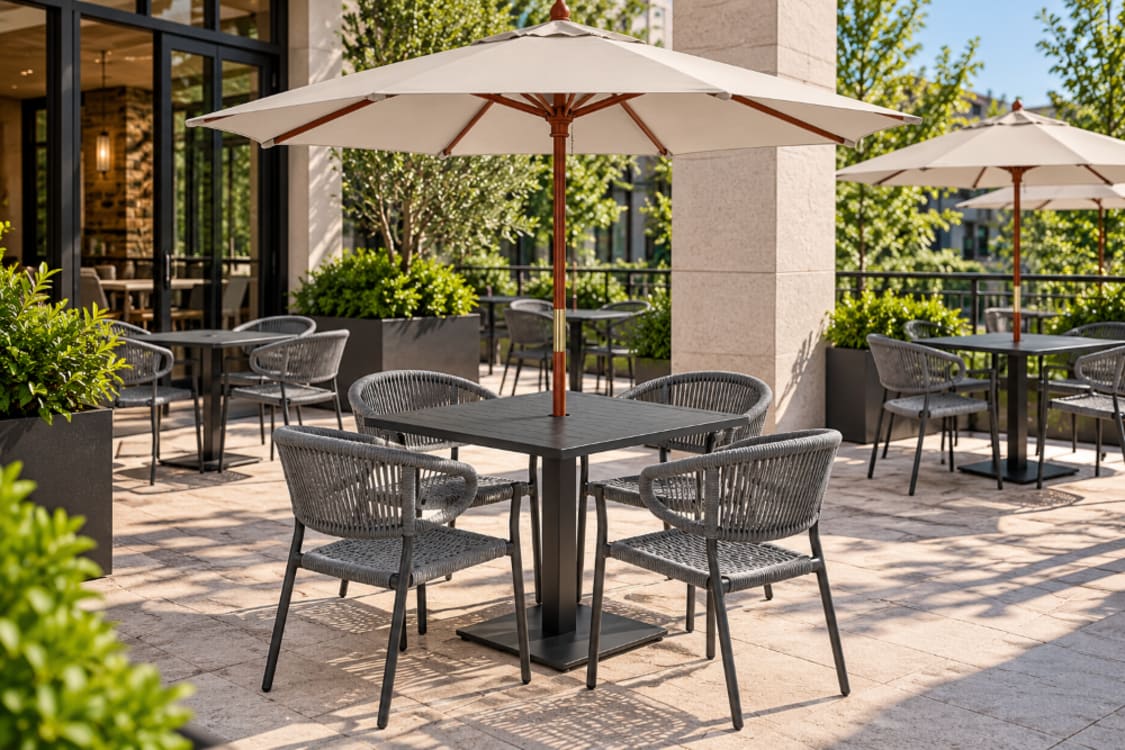
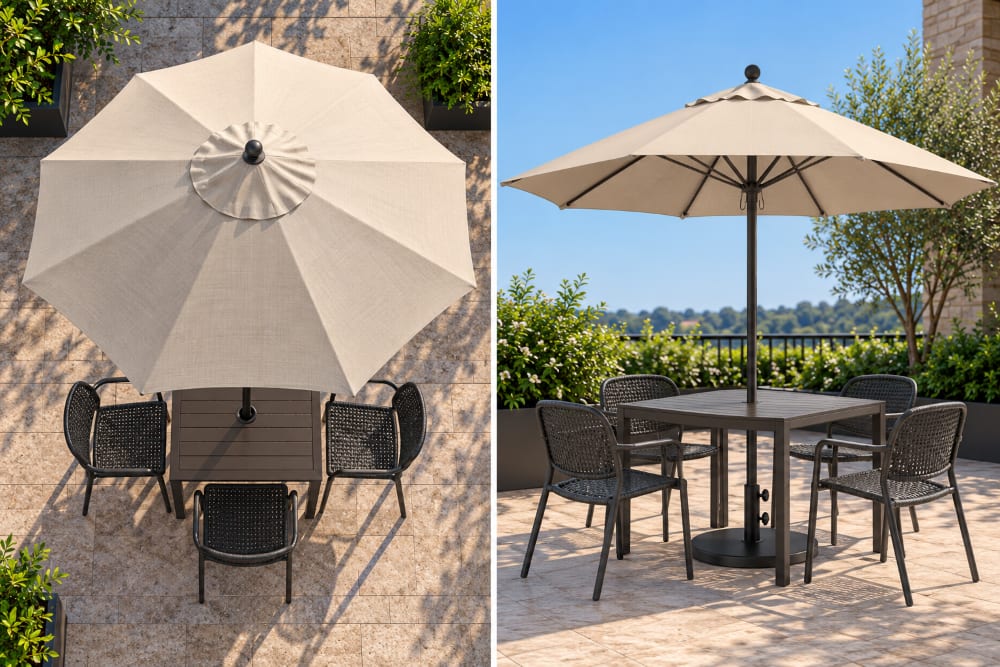
Where the Umbrella Really Takes Up Space
The views below show the same umbrella setup from above and from the side, making it easier to compare the canopy footprint with the table, chairs, pole, and support below.
Umbrella Bases Are Part of the Floor Plan
The canopy may be overhead, but the umbrella support consumes real space on the patio. A standalone base needs a location that does not create unnecessary conflicts with chairs, guests, or circulation. When a center-pole umbrella passes through a table, check the relationship between the table base and umbrella support below the tabletop as well.
Some configurations combine table and umbrella support in a single base, while others use separate components. In either case, account for the support at floor level from the beginning instead of fitting it into whatever space remains after the tables are placed. If umbrellas are routinely moved or stored, also consider how staff will handle the complete setup without creating another obstacle during service.
Wind Changes the Equation
An open umbrella presents a large surface to moving air. Wind exposure can also vary across a patio, especially around building corners, open edges, rooftops, and other exposed locations.
Use the umbrella with an appropriate support system and follow the manufacturer's guidance for setup, operation, closing, and storage. Avoid relying on the weight of nearby tables or chairs as a substitute for proper umbrella support or operating practices.
There is no single wind-speed rule that applies to every commercial umbrella and installation.
Permanent Cover Changes the Exposure
A roof, awning, or other permanent cover can reduce the amount of direct sun and precipitation reaching part of a patio. It may also change where supplemental shade is useful.
The space is still outdoors. Architectural cover does not automatically make indoor furniture suitable for exterior use or remove the need to follow outdoor product specifications and care instructions.
Treat permanent cover as one of the site conditions identified earlier in the planning process. Select furniture and shade equipment according to the conditions they will actually encounter.
Learn More About Commercial Patio Umbrellas
This section focuses on how shade interacts with the furniture and patio layout. For a closer look at umbrella sizing, construction, canopy materials, lift mechanisms, bases, and other umbrella-specific considerations, see our Patio Umbrella Technical Guide.
✓
Design Takeaway
Plan the Shade With the Seating
Plan shade around the complete dining position rather than the tabletop alone. Look at where the canopy sits above occupied chairs, where the pole travels, and where the support lands on the patio. Then account for wind, sun, architectural cover, and the way staff will operate or move the umbrella during normal service.
Once outdoor suitability, furniture type, tables, layout, and shade have been worked out, appearance becomes a much more useful decision. The remaining choices already meet the practical needs of the patio. Now they can be narrowed according to what belongs with the restaurant.
Start with what is already there. The interior establishes part of the restaurant's identity, while the building, flooring, railings, surrounding materials, and views give the patio its physical setting. Furniture can connect those environments without trying to make the outdoor space look exactly like the dining room inside.
The result should feel recognizable as part of the same restaurant while still making sense outdoors.
Connect Indoor and Outdoor Design Without Copying It
An outdoor dining area does not need the same furniture as the interior to feel connected to it. Look instead for visual cues that can move naturally between the two spaces.
Color is one of the easiest connections to make. A dominant neutral, dark metal accent, warm wood tone, or recognizable brand color can appear outdoors through materials designed for exterior use. Furniture silhouette can create another connection. Chairs with similar proportions, back shapes, or visual weight can relate to the interior even when their construction is completely different.
Material character can work the same way. An interior built around natural wood does not require the same wood furniture outside. An outdoor-appropriate material with a related tone or visual character may establish the connection without sacrificing the performance the patio requires. Choose a few recognizable cues rather than trying to reproduce the dining room outdoors.
Let the Architecture Lead
Before introducing another color, finish, or material, look at what already dominates the patio. The building facade, flooring, railings, structural elements, existing colors, landscape, and surrounding views can provide much of the design direction.
Furniture does not have to match those elements literally. Contrast can be useful when it helps the furniture remain visually distinct from the background. A simple dark metal chair may stand out against pale masonry, while lighter furniture can provide separation from a dark facade or dense architectural setting.
Pay attention to permanent elements first. Brick, stone, concrete, wood, metalwork, tile, and other architectural materials will usually remain long after individual furniture pieces are replaced. Existing lines and shapes matter too. A patio dominated by straight architectural edges creates a different setting than one surrounded by softer landscaping and irregular forms.
Use Furniture to Define Different Patio Areas
A larger patio does not have to use the same furniture arrangement from one end to the other. Dining-height tables can establish the primary area for full meal service, while bar-height seating may work along a railing, beside an outdoor bar, or anywhere taller seating serves a specific purpose. Waiting or social areas can use a different arrangement when the restaurant needs them, and communal seating can accommodate regular group use without becoming the default for every large open space.
These differences should reflect how the restaurant actually uses each part of the patio. Changing furniture simply for visual variety can make the space harder to rearrange without improving the guest experience. Subtle changes in table height, chair style, table size, or arrangement are often enough to distinguish one use from another while keeping the patio visually connected.
Three Patios, Three Different Answers
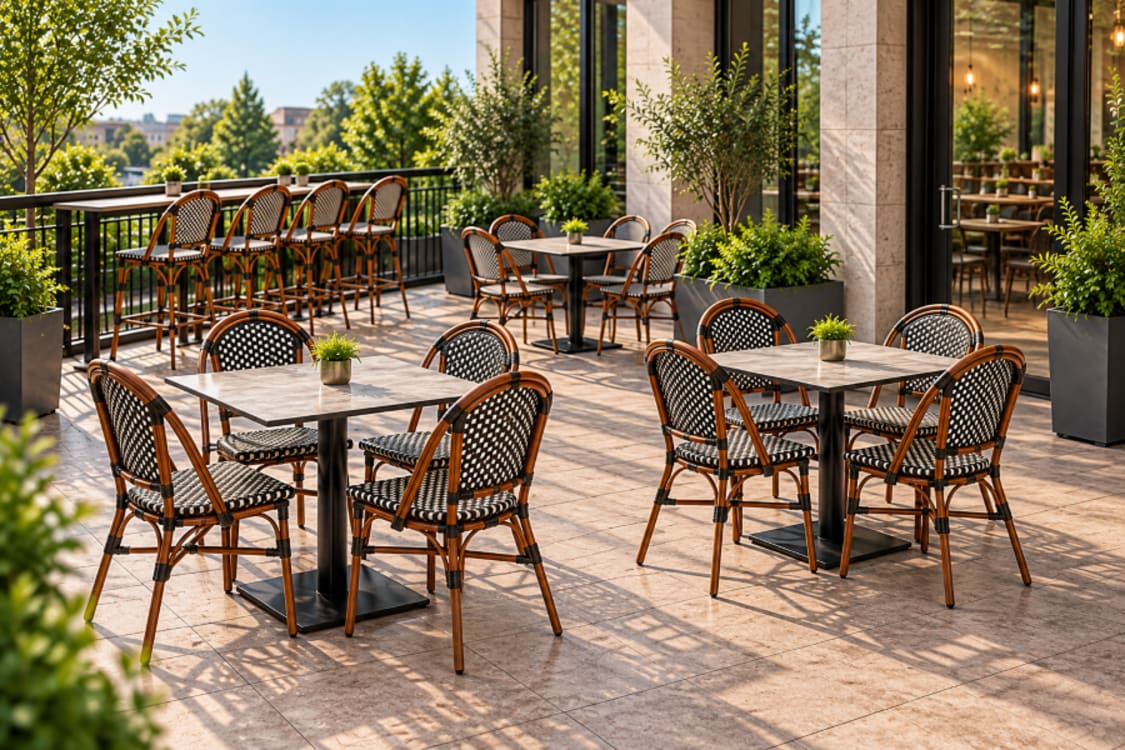
There is no single visual formula for a restaurant patio. Architecture, interior design, surroundings, service style, and the way the outdoor area is used can lead to very different furniture choices. The strongest examples respond to what is already distinctive about the restaurant instead of applying the same outdoor look everywhere.
Architecture-Driven
Let the setting establish the visual direction
Architecture can narrow the furniture choices before individual styles are compared. A visually heavy masonry patio may support different furniture proportions and finishes than a light glass-and-metal terrace, while a compact sidewalk setting may call for a quieter visual footprint.
Look for furniture that responds to the scale and character of the setting through proportion, color, material character, or contrast. It does not need to imitate the building to belong there.
Concept-Driven
Use the restaurant identity to narrow the style
A sidewalk cafe, contemporary restaurant, casual bar, or traditional dining concept can suggest different furniture shapes, colors, and material character. A recognizable silhouette or restrained palette may be enough to establish the connection.
Use concept as a filter after practical requirements have narrowed the choices. Style should help distinguish between furniture that already works for the patio.
Furniture Defines the Use
Let seating choices communicate how each area works
Different furniture arrangements can help guests understand the patio. Dining-height tables establish meal seating, while bar-height seating can distinguish a railing, counter, or other area with a different purpose.
Table size and arrangement can make similar distinctions for couples, groups, or communal seating. Those differences should follow actual service needs so visual variety also serves a practical purpose.
✓
Design Takeaway
Let the Restaurant Give the Patio Its Direction
The restaurant already provides many of the cues needed to design its patio. Look at the interior, architecture, permanent materials, colors, surroundings, and the way different parts of the outdoor area will be used. Carry the strongest of those cues into outdoor-appropriate furniture instead of giving the patio an unrelated theme of its own.
Patio furniture continues to create work after the buying decision is over. It has to be cleaned, checked for wear, moved when conditions require it, and sometimes stored for part of the year. How much work that creates depends on the furniture and on how the restaurant operates.
Consider those responsibilities while comparing products rather than after the patio is furnished. A chair that is easy to clean but difficult to move presents a different ownership problem than a lightweight chair with more detailed surfaces. A finish that requires particular care may be perfectly practical when staff can provide it consistently.
The useful question is not whether patio furniture is described as low maintenance. It is whether the care required by the furniture fits what the restaurant can realistically do.
Daily Care
Think about what happens during a normal week. Tables are wiped, chairs are moved for cleaning and resets, and umbrellas may be opened, closed, or repositioned. Construction and surface design can affect how much work those routines create.
Compare what the furniture asks of staff with the restaurant's cleaning practices and daily routine. The goal is to choose furniture whose regular care can be handled consistently across the complete patio.
Routine Inspections
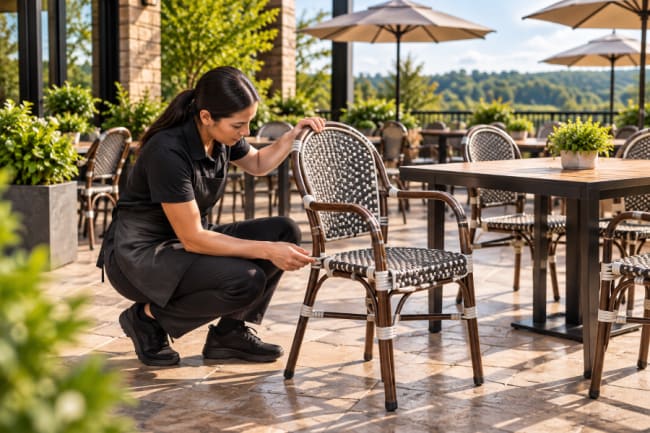
Regular handling gives staff a chance to notice damaged glides, rocking tables, loose hardware, worn finishes, or problems with frames and joints. Woven furniture and umbrellas may have additional components that should be checked according to manufacturer instructions.
The inspection schedule should fit the furniture rather than follow an arbitrary timetable. Identifying loose fasteners, damaged glides, and other serviceable components early can prevent minor maintenance needs from becoming larger problems.
Material-Specific Cleaning
Outdoor-rated furniture does not all clean the same way. Appropriate methods depend on the material, finish, construction, and manufacturer instructions. Slats, woven surfaces, joints, seams, and textured areas can also require more attention than broad, smooth surfaces.
Remove food, spills, dust, and debris routinely, then use products and methods appropriate for the furniture. Once a specific product is selected, its care instructions should take precedence over general assumptions about the material.
Storage Planning
Some patio furniture remains outside after closing, while other pieces may be stacked, secured, moved under cover, or stored. Severe weather and seasonal closures can create additional handling requirements, and umbrellas may have different storage needs than tables and chairs.
Make those decisions before ordering. Consider how the furniture is intended to be handled and stored, and check any manufacturer guidance that applies before establishing the restaurant's storage routine.
Storage Planning Considerations
Plan storage around the full order rather than a single sample chair. Twenty stackable chairs can require far less floor space than twenty non-stackable chairs, so confirm whether the selected seating stacks, any stated stacking limits, and the space the complete chair quantity will require. If the furniture normally remains on the patio, storage efficiency may carry less weight than comfort, construction, appearance, or other characteristics.
Then trace the route between the patio and storage area. Doors, gates, stairs, elevators, narrow passages, and changes in level can affect how practical it is to move furniture in quantity. Tables, bar stools, umbrellas, and umbrella bases may also have different storage requirements, so make sure the available space and access work for the complete furniture package rather than the chairs alone.
✓
Design Takeaway
Plan for the Furniture After Closing
A patio chair has one job while a guest is sitting in it and a different set of demands when the restaurant closes. Know how the furniture will be cleaned, checked, moved, protected, and stored before ordering it in quantity. The easier those responsibilities fit the restaurant's normal routine, the easier the patio is to manage over time.
A patio furniture order brings together decisions made across the entire space. The chairs may be right for outdoor use but difficult to store. The tables may fit the party mix but leave too little room once guests are seated. An umbrella may fit through the tabletop but lack the right support below it.
Before placing the order, check the furniture as a complete patio package. Confirm the site conditions first, then work through seating, tables, layout, and the responsibilities that begin after the furniture arrives.
1
Before Ordering
Site
-
Exposure is understood. You know where sun, moisture, wind, temperature changes, and other outdoor conditions affect the patio.
-
The patio surface has been considered. Furniture and bases have been evaluated on the surface where they will actually sit.
-
Fixed obstructions are measured. Railings, columns, planters, entrances, gates, and other permanent features are included in the usable patio area.
-
Storage has been identified. You know where furniture will go when it needs to be moved or stored.
2
Before Ordering
Seating
-
Commercial outdoor use is confirmed. The complete chair or bar stool is appropriate for the intended commercial outdoor setting.
-
Chair and stool types are selected. Dining chairs, armchairs, bar stools, or other seating formats match how each area will be used.
-
Comfort fits the dining style. Seat shape, back support, arms, and proportions make sense for the expected length and type of service.
-
Weight and mobility are appropriate. Staff can handle the furniture when it needs to move, while the selected weight makes sense for the patio conditions.
-
Stacking requirements are confirmed. If chairs need to stack, the selected models are designed to do so and there is a practical place to store the stacks.
3
Before Ordering
Tables
-
The tabletop is suitable for outdoor use. Its material, construction, edges, and finish are appropriate for the intended setting.
-
The table base is suitable for outdoor use. The base is appropriate for the environment and the surface where the table will stand.
-
Top and base compatibility is confirmed. The complete assembly works with the selected top size, shape, weight, mounting requirements, and intended use.
-
Sizes and shapes fit the party mix. The table package supports the combinations of guests the restaurant regularly expects to seat.
-
Umbrella compatibility is checked where needed. The tabletop, pole path, support, and base configuration work together as a complete setup.
4
Before Ordering
Layout
-
Furniture has been tested in occupied positions. The plan accounts for chairs and guests, not tabletop dimensions alone.
-
Service movement has been accounted for. Staff can reach and move around occupied tables without depending on chairs remaining pushed in.
-
Umbrella bases are included in the floor plan. Supports below the canopy are treated as part of the furniture footprint.
-
Accessible and local requirements have been verified. The final arrangement is checked against the requirements that apply to the restaurant and site.
5
Before Ordering
Ownership
-
Cleaning requirements are understood. Staff know the appropriate care methods for the selected materials, finishes, and products.
-
The storage plan works at full quantity. The restaurant has considered where the complete order will go, not simply whether an individual chair stacks.
-
Manufacturer care instructions are retained. Product-specific cleaning, handling, inspection, and storage guidance is retained and remains available after installation.
-
Future replacement or additions have been considered. Where matching furniture later matters, availability, replacement components, or future expansion can be considered before the initial order is finalized.
Final Thoughts
A successful patio starts with furniture that fits the conditions of the site and the way the restaurant actually operates. Construction, material, size, weight, handling, and care requirements all matter because those characteristics affect what staff and guests experience every day.
When those choices match the patio, tables and seating are easier to manage, maintain, and use throughout the season. The result is an outdoor dining area built around the restaurant's real service needs instead of a collection of products chosen in isolation.
At Affordable Seating, we work with restaurants planning everything from a few outdoor tables to complete patio dining areas. Our commercial patio collection includes chairs, bar stools, tables, bases, and umbrellas in a range of materials and styles, giving you room to build around the needs of your site rather than forcing the patio around a limited furniture package.