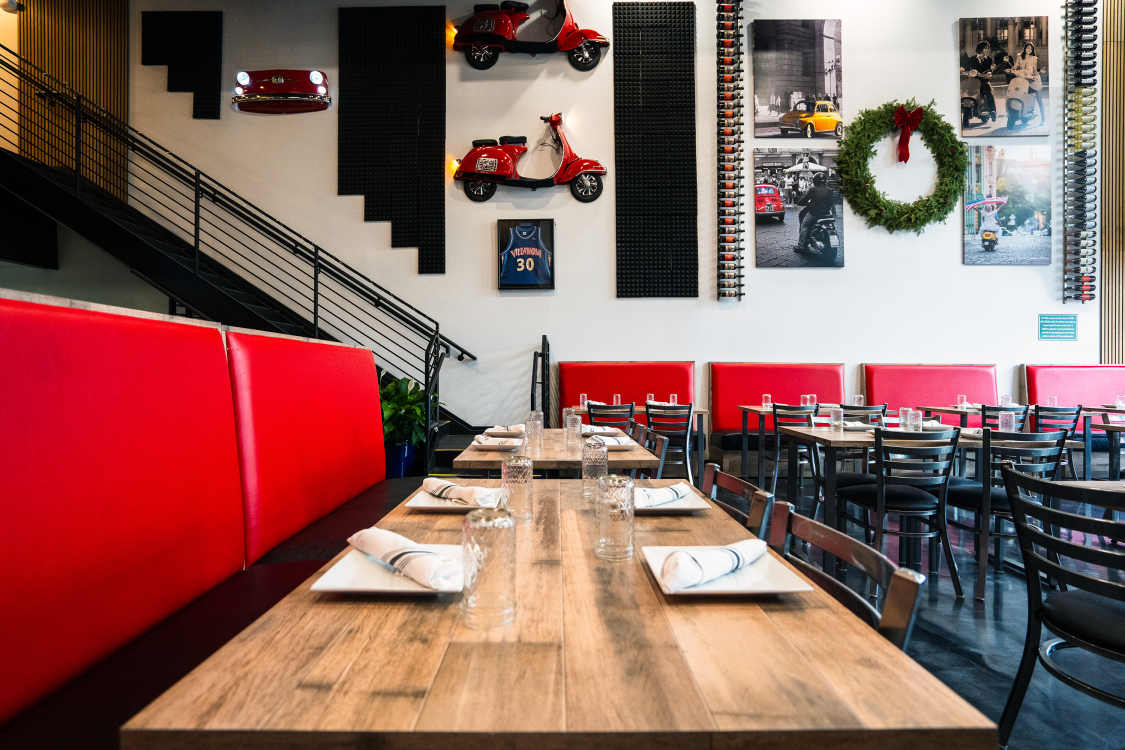
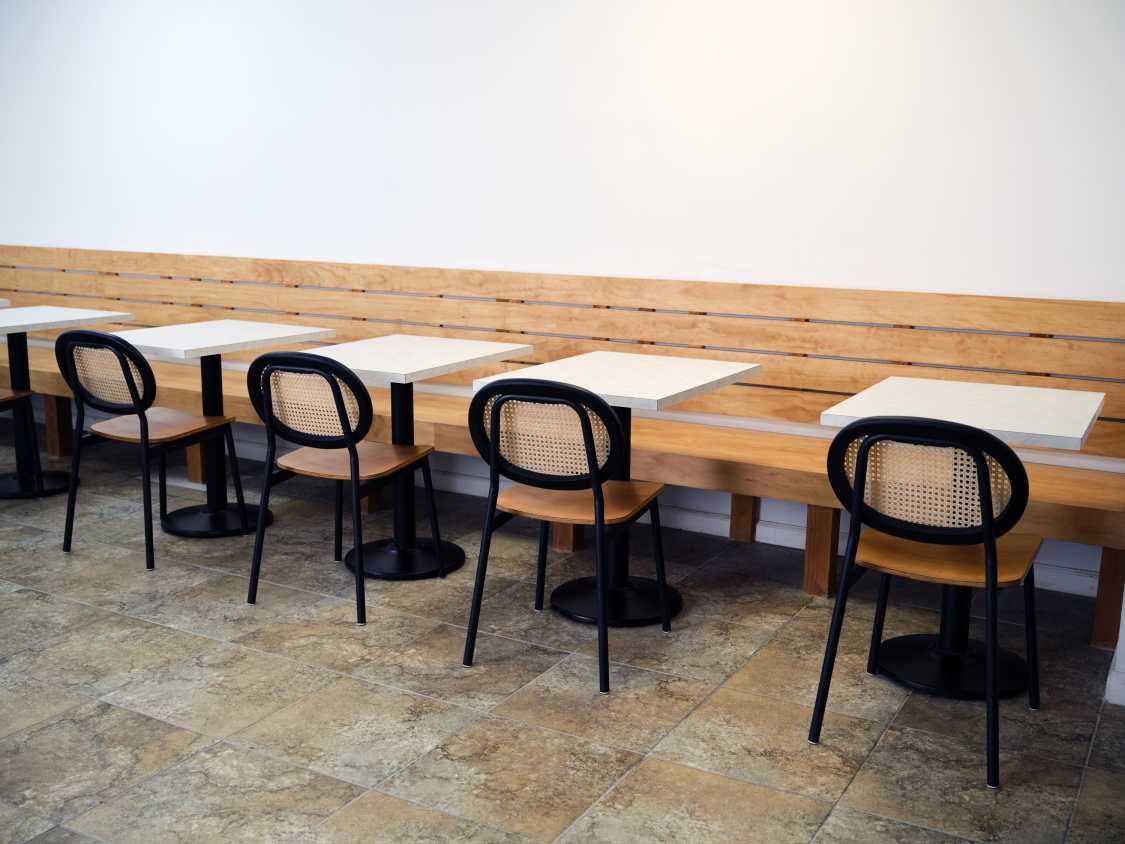
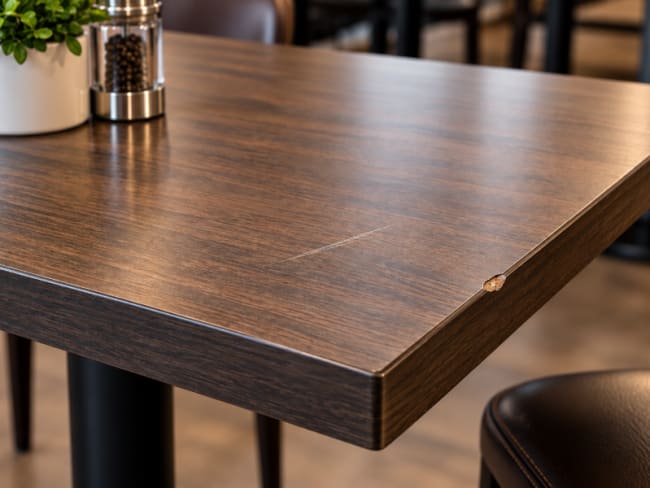
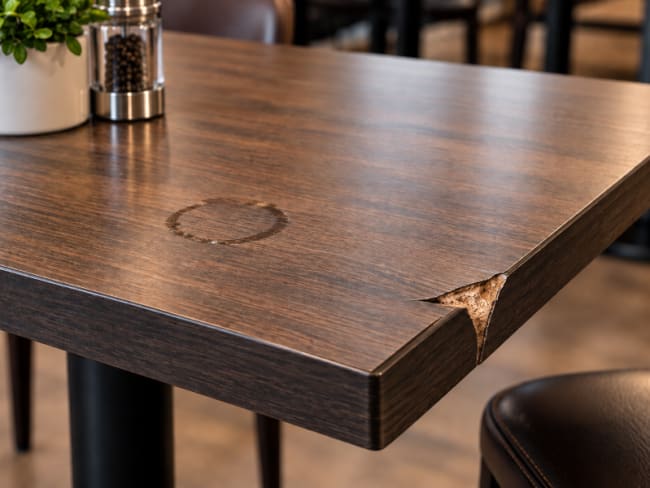
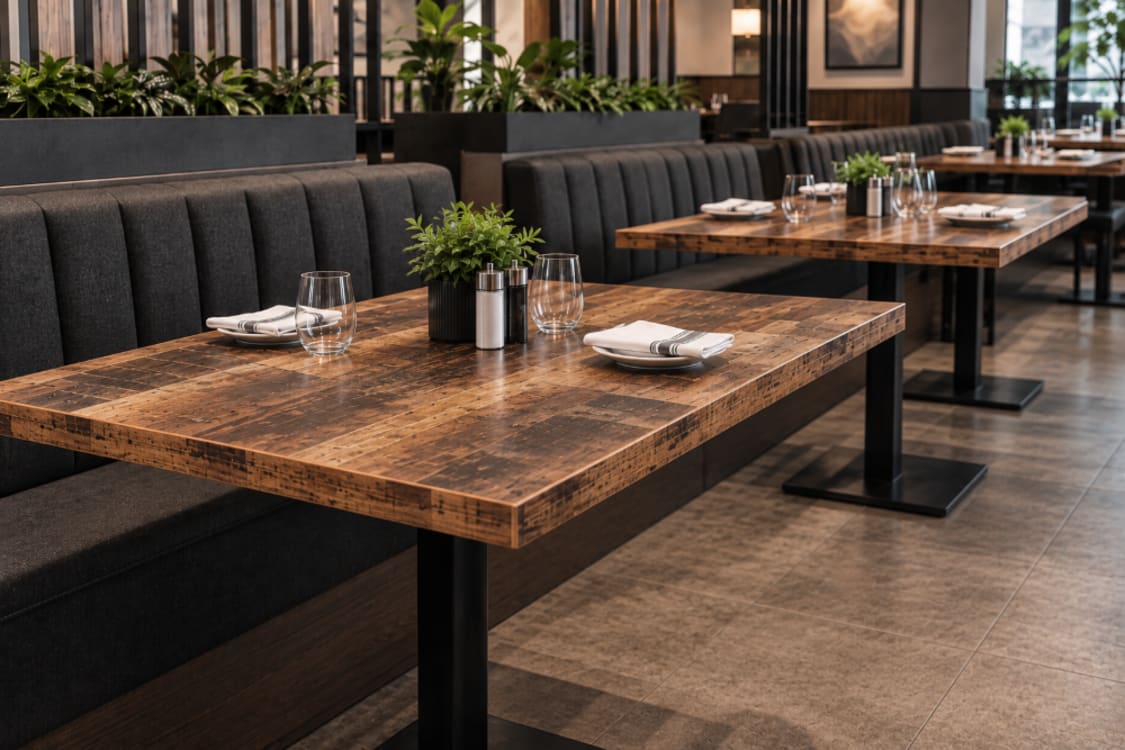
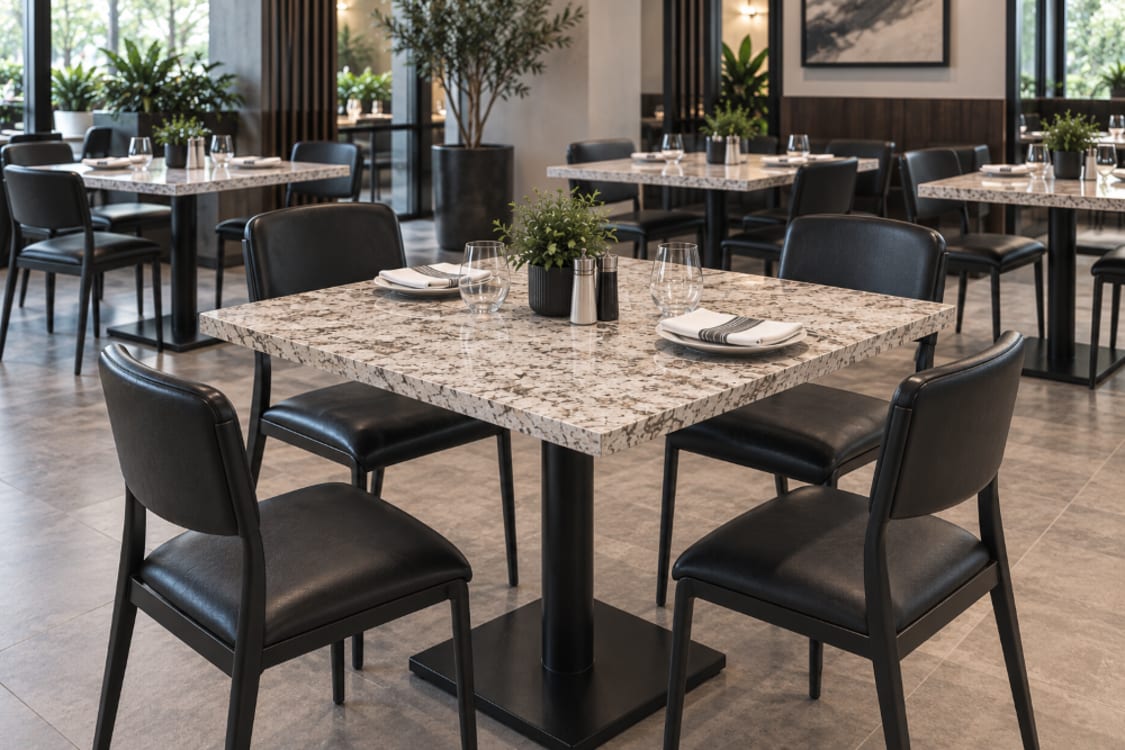
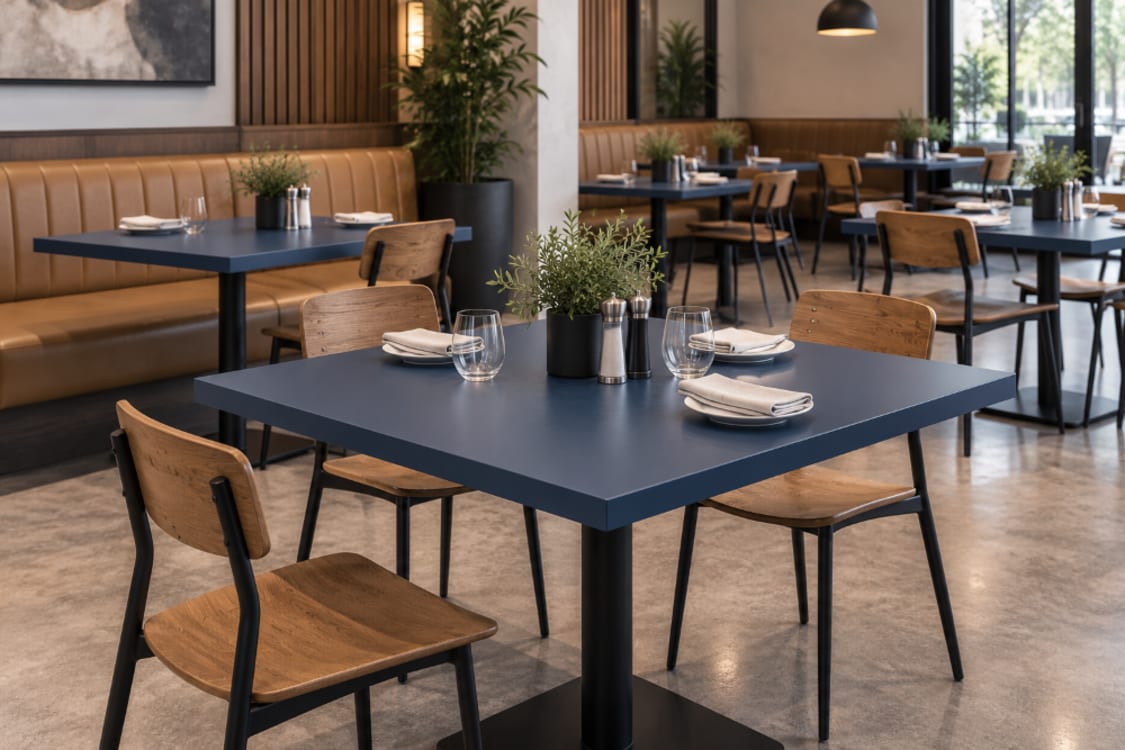
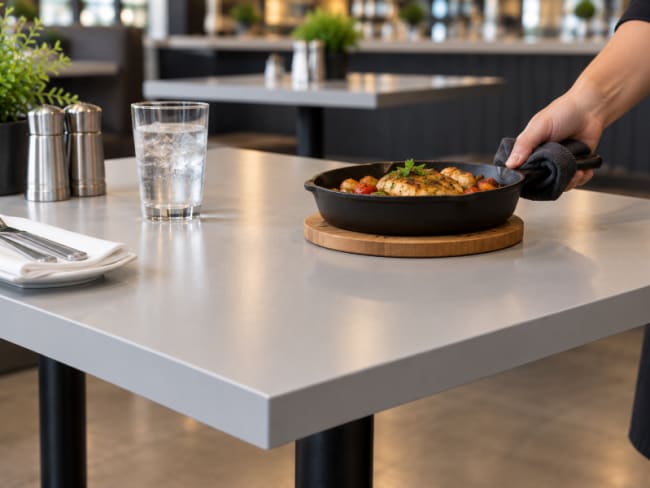
From across the dining room, a laminate table top appears to be a single finished surface. Most of its construction is hidden. Beneath the decorative laminate is a layered assembly that provides the top's thickness and structure, finishes the underside, and protects the exposed perimeter.
That construction matters when comparing commercial table tops. Two products can use the same laminate pattern and look nearly identical in a photograph while differing in core material, finished thickness, backer, edge construction, and other specifications. Looking beneath the surface makes those differences easier to understand.
How a Laminate Table Top Is Built
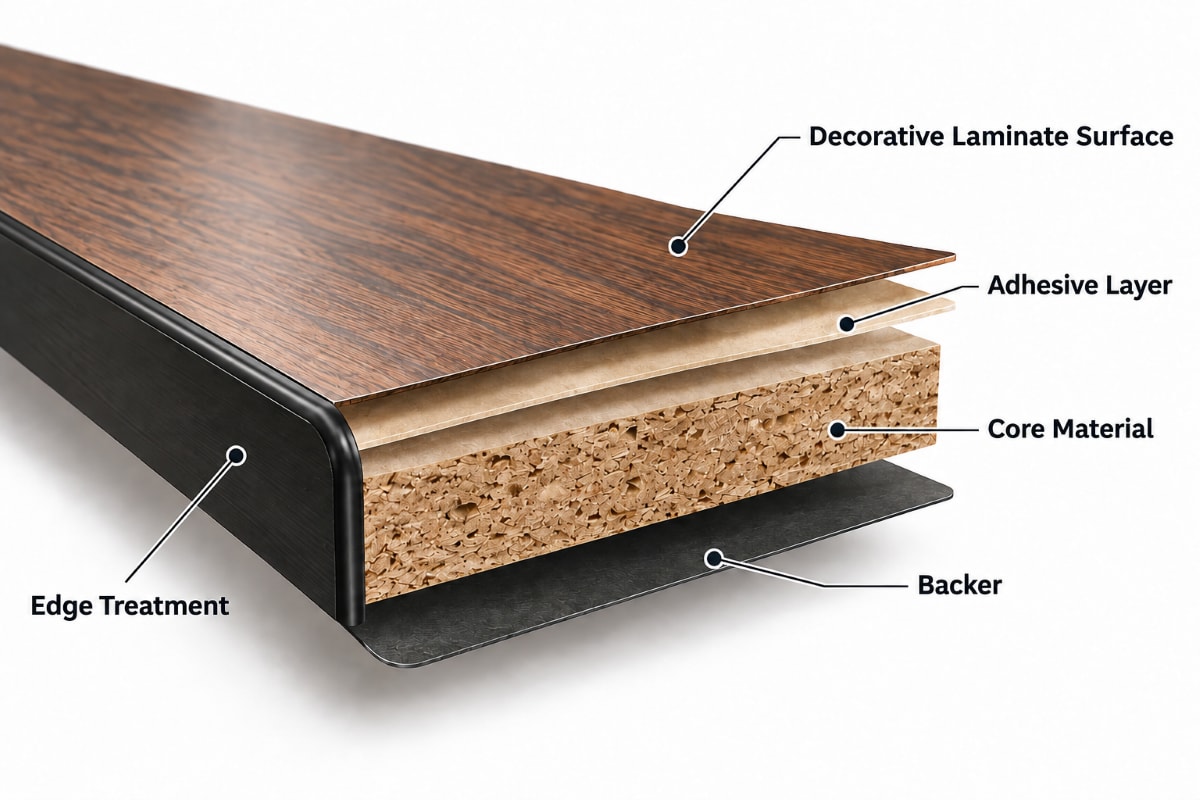
A typical commercial laminate table top can be understood as five basic components: the decorative laminate surface, adhesive layer, engineered core, backer, and edge treatment. Exact materials and manufacturing methods vary among products, but each component performs a distinct job in the finished assembly.
The Decorative Laminate Surface
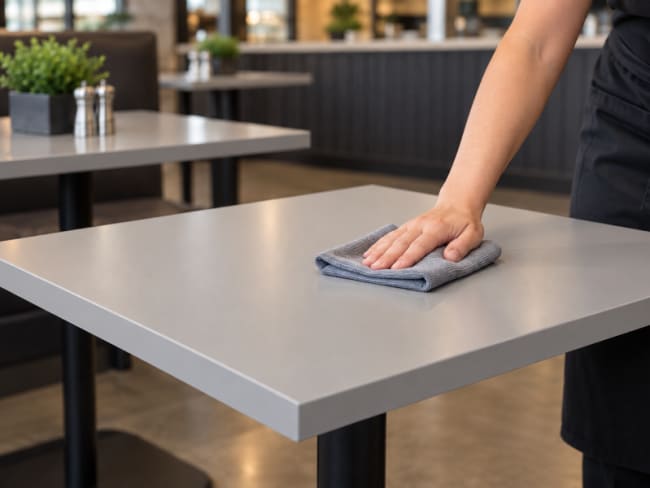
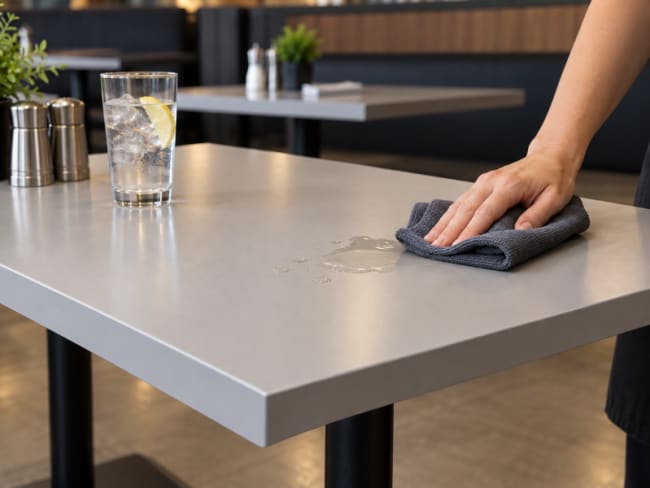
The laminate is the part diners see and touch. High-pressure laminate is manufactured as a relatively thin decorative sheet and then bonded to the substrate beneath it. The laminate provides the table's color, pattern, texture, and finished dining surface, but it does not provide most of the table top's thickness.
The Bond Between Surface and Core
Between the laminate and core is the adhesive layer that joins the two materials into a finished panel. It receives little attention because it disappears from view during manufacturing, but a laminate sheet cannot function as a restaurant table surface until it is securely bonded to a supporting substrate.
Adhesives and manufacturing processes vary, and this normally isn't a component restaurant buyers select independently. Its importance is understanding the construction: the laminate is applied to the core rather than being the core itself.
The Engineered Core
The core provides most of the table top's thickness and structural body. Particleboard is common in commercial laminate table tops, while MDF and other substrates are also used depending on the product and manufacturer.
Core specifications are worth checking rather than assuming all laminate tops are built alike. Density, material, and thickness can vary even when two finished surfaces look virtually identical.
Affordable Seating provides a useful commercial example. Its self-edge laminate table top uses a 45-lb industrial-grade particleboard core as part of a finished 1 1/4-inch construction. That is a specification for that particular product, not a universal standard for commercial laminate tops.
The Backer and Underside
Turn a laminate table top over and there is another part of the construction that is easy to miss in product photography. A backer is applied to the underside as part of the finished panel assembly.
Its exact material and function depend on the product. Backers may finish and protect the underside, help guard the core against moisture, and contribute to the construction of the panel. Affordable Seating's commercial laminate tops, for example, use a thermally fused backer.
The Edge Completes the Table Top
Once laminate has been bonded to a core, the exposed perimeter still needs to be finished. That is the job of the edge treatment.
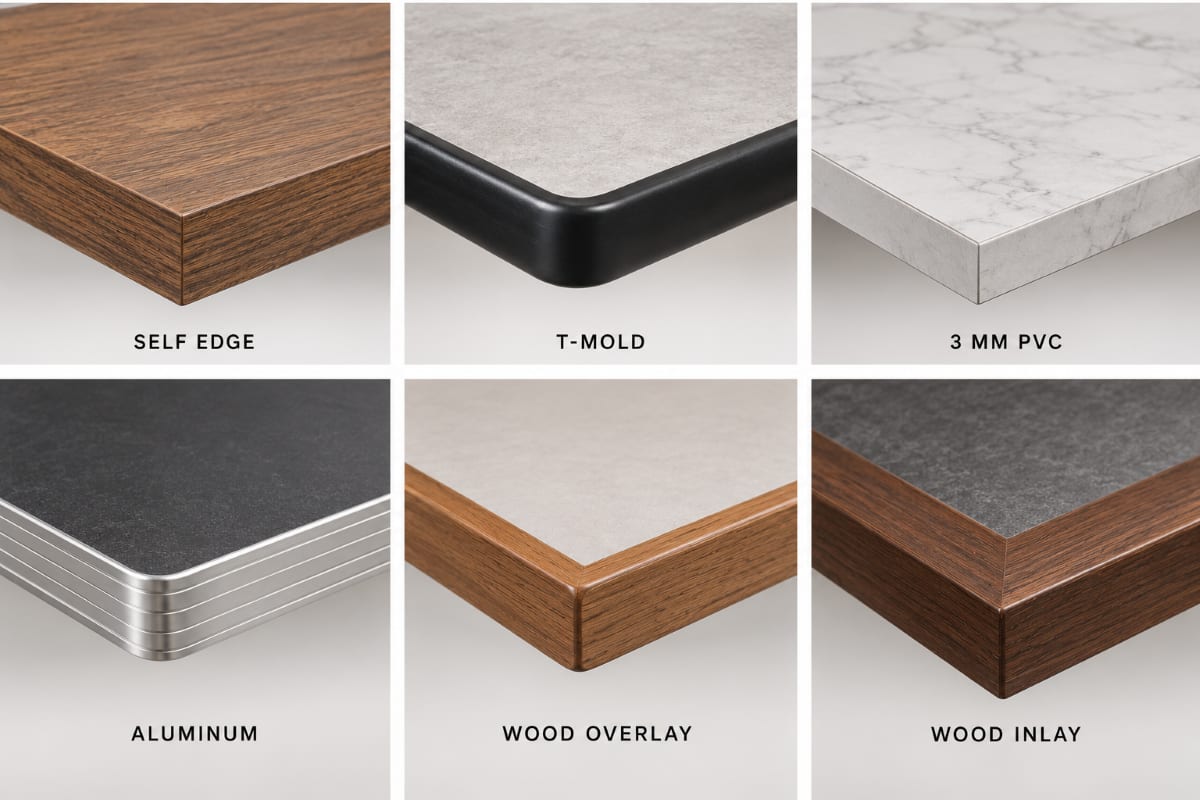
A self edge, T-mold, PVC edge, aluminum edge, or real-wood perimeter does more than change the appearance of the table. Each finishes the exposed core differently and creates its own perimeter profile, corner treatment, and material transition.
We'll examine those constructions individually later in this guide. At this stage, the important distinction is that the edge is a component of the table top, not simply decoration added after the surface has been selected.
What Each Layer Contributes
The individual components are easier to compare when their jobs are separated:
|
Component
|
Primary Job
|
What It Affects
|
|
Decorative Laminate
|
Primary Job
Provides the exposed dining surface and visible finish.
|
What It Affects
Color, pattern, texture, surface appearance, and everyday contact with food, dishes, and cleaning.
|
|
Adhesive / Bond
|
Primary Job
Bonds the laminate securely to the supporting substrate.
|
What It Affects
Integrity of the surface-to-core assembly and how securely the laminate remains attached during use.
|
|
Core
|
Primary Job
Provides most of the table top's structural body and thickness.
|
What It Affects
Overall construction, finished thickness, weight, and the material beneath the laminate surface.
|
|
Backer
|
Primary Job
Finishes the underside of the panel as part of the complete table-top assembly.
|
What It Affects
Underside finish, protection of the core, and, depending on the product, moisture resistance and panel construction.
|
|
Edge Treatment
|
Primary Job
Finishes and protects the exposed perimeter of the table top.
|
What It Affects
Edge appearance, material transition, corner profile, perimeter protection, and how the exposed edge handles everyday contact.
|
What Does a Commercial Laminate Table Top Specification Look Like?
Put those components together and a product description starts making
considerably more sense. Affordable Seating's self-edge laminate table top
provides one real-world example:
Finished Thickness:
1 1/4"
Core:
45-lb industrial-grade particleboard
Surface:
Horizontal-grade laminate
Backer:
Thermally fused backer
Edge:
Self-edge construction
The example is useful because it shows how individual construction terms
become a complete product specification. It should not be read as the
definition of a commercial laminate table top. Other products may use
different core materials, densities, finished thicknesses, backers, and
edge constructions.
That's also why a single specification rarely tells the whole story. A
1 1/4" top is thicker than a 1" top, for example, but thickness alone does not
establish that one table top is automatically better or more durable. The
complete construction and intended application still matter.
✓
Design Takeaway
From Construction to Performance
The laminate surface is only one part of the table top. Core, backer, adhesive, and edge construction complete the assembly, so compare the finished product rather than judging a table top by its visible surface alone.