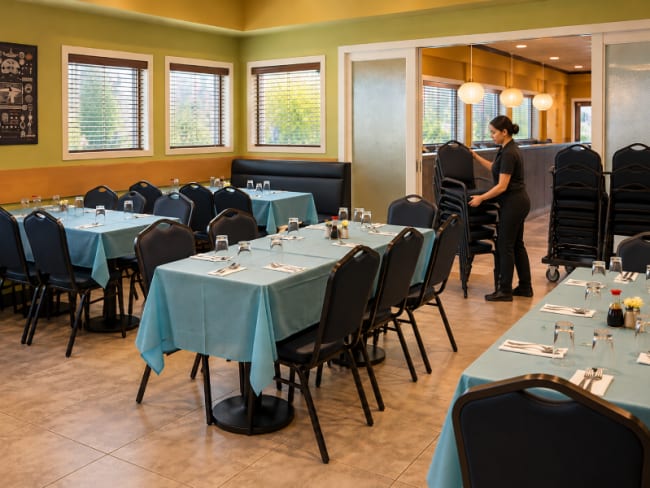
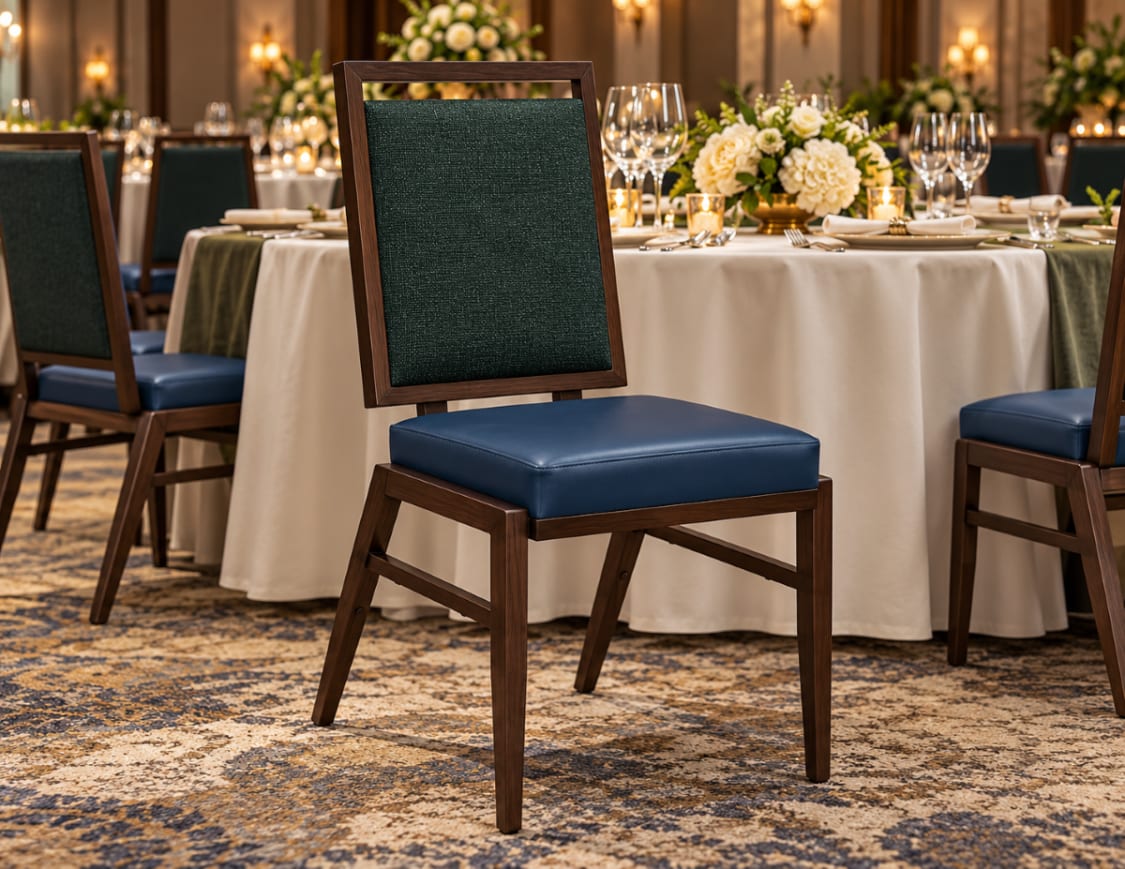
Restaurant chairs, banquet chairs and senior living chairs can look surprisingly similar at first glance. They may use the same frame materials, upholstered seats and backs, commercial finishes, and even similar construction methods. Some models can also work in more than one type of facility, which makes the category name alone a poor way to judge whether a chair is right for a particular space.
The differences become clearer when you look at what the chair is expected to do every day. A restaurant chair may spend most of its working life around a dining table, while senior living seating places greater emphasis on the needs of residents and staff. Banquet chairs are frequently moved, stacked, stored and set up again as rooms change between events. Understanding those different jobs makes it much easier to compare the features that actually matter.
Restaurant vs. Banquet vs. Senior Living Chairs at a Glance
Restaurant, banquet and senior living chairs can use similar materials and features while serving different types of facilities. This quick comparison shows where each category generally fits and which characteristics tend to matter most in that setting.
|
Chair Type
|
Best Fit
|
Construction & Comfort
|
Movement & Storage
|
Common Specialized Features
|
Primary Buying Question
|
|
Restaurant Chairs
|
Best Fit
Restaurants, cafés, bars and other commercial dining spaces
|
Construction & Comfort
Broadest range of wood, metal, aluminum and upholstered designs. Arms and cushioning are available but vary widely by style.
|
Movement & Storage
Usually moved for cleaning, seating adjustments and normal service. Some models stack, but storage efficiency is generally not the defining priority.
|
Common Specialized Features
Wide design range, multiple frame materials, arm and armless options, upholstery choices and model-specific stacking or handling features.
|
Primary Buying Question
How well does the chair fit the dining concept, tables and demands of everyday service?
|
|
Senior Living Chairs
|
Best Fit
Senior living communities, residential dining rooms and similar hospitality environments
|
Construction & Comfort
Commonly aluminum or other durable commercial construction, with upholstered seats and backs especially prevalent. Arms are common and can provide a useful support point when sitting or rising.
|
Movement & Storage
Often repositioned by residents or staff. Stackability may be available, but ease of daily handling usually matters more than high-density storage.
|
Common Specialized Features
Arms, supportive cushioning, handholds, glides and model-specific caster options are common considerations.
|
Primary Buying Question
How well does the chair work for the people sitting in it and the staff handling it every day?
|
|
Banquet Chairs
|
Best Fit
Banquet halls, ballrooms, conference facilities and event venues
|
Construction & Comfort
Primarily metal construction, commonly aluminum or steel, with upholstered seats and backs widely available. Arm chairs exist, but armless designs are common.
|
Movement & Storage
Designed around frequent setup, breakdown, stacking and storage. Chair weight and stacking quantity become increasingly important when large numbers of chairs are moved.
|
Common Specialized Features
High stacking capacity, handholds, flex backs and optional ganging systems are common within the category.
|
Primary Buying Question
How efficiently can the chair be moved, configured, stacked and stored as the room changes?
|
No single material or feature defines one of these categories. What separates them is the way construction, seating configuration and handling features respond to the demands of the setting. The next section looks at those demands before comparing the specifications themselves.
What Actually Changes From One Chair Type to Another?
The intended setting changes what a chair is asked to do throughout the day. Three relationships are especially useful when comparing commercial seating: the chair's place in the room, the experience of the person using it and the way staff handle it.
The Chair's Relationship With the Room
Table Fit, Footprint and the Dining Floor
Restaurant chairs typically spend most of their working life around dining tables, making their relationship with the room especially visible. Chair width and depth affect how seating fits around the table, while the overall footprint influences spacing between neighboring tables and the circulation space around them.
Appearance also carries greater weight when chairs remain on the dining floor throughout service. Frame material, upholstery, finish and silhouette become part of the restaurant interior rather than features seen only during a particular event. The chair therefore has to work physically with the table and floor plan while also making sense as a permanent part of the dining room.
The Chair's Relationship With the User
Daily Seating Changes Which Details Matter
Restaurant seating has to work efficiently with the table and surrounding floor plan while accommodating a broad dining population. Senior living seating brings closer attention to the individual seating position, including seat height, width and depth, cushioning, back support and the availability of arms.
Those details can affect how the chair feels and functions during repeated daily use. Arms may provide a useful support point when a resident sits down or rises, while upholstery and seat proportions can influence comfort over longer dining periods. The goal is not a single universal chair design, but a combination of features that suits the people expected to use it.
The Chair's Relationship With Staff
Handling Becomes a Design Consideration
Moving a chair occasionally is very different from handling large quantities during an event reset. As that work becomes more frequent, chair weight, handholds and stacking capacity have greater practical consequences. Banquet seating reflects that pressure most clearly because setup, breakdown and storage are routine parts of its use.
Those demands continue after a chair leaves the event floor. Chairs may need to be carried, stacked, transported to storage and returned for the next setup. A lighter chair, accessible handhold and greater stacking capacity can reduce the work involved each time the room changes.
Different Demands, Shared Features
These demands are not exclusive to one setting. A restaurant may need chairs that stack, and a senior living facility may have rooms that change configuration. What matters is how often a particular demand occurs and how well the chair is equipped to handle it.
That makes the specification sheet the next useful comparison. The same feature can have very different practical value depending on where and how often it is used.
The Features That Look the Same Until You Compare Them
Product photographs can make two commercial chairs appear interchangeable even when their specifications point to very different uses. The table below compares how common chair features function across restaurant, senior living and banquet settings.
|
Feature
|
Restaurant Chairs
|
Senior Living Chairs
|
Banquet Chairs
|
|
Frame Materials
|
Restaurant Chairs
Wood and metal are both widely used, with construction selected according to the dining environment, appearance and service demands.
|
Senior Living Chairs
Aluminum is common because it combines commercial durability with relatively low frame weight and can be finished in a range of styles.
|
Banquet Chairs
Metal construction is prevalent, particularly where repeated handling and stacking are expected.
|
|
Arms
|
Restaurant Chairs
An available seating choice that affects comfort, appearance, chair width and table fit.
|
Senior Living Chairs
Common and particularly useful because they can provide a support point when sitting down or rising.
|
Banquet Chairs
Available on some models, although arms can affect chair width, seating density and stacking.
|
|
Upholstery
|
Restaurant Chairs
Used selectively for comfort and appearance, from padded seats to fully upholstered chairs.
|
Senior Living Chairs
Common on seats and backs, making cushioning, fabric or vinyl selection, cleaning and maintenance important considerations.
|
Banquet Chairs
Commonly used to provide comfortable seating and a coordinated appearance across large event spaces.
|
|
Stackability
|
Restaurant Chairs
Useful where chairs need to be cleared or stored, but not a requirement for most restaurant seating.
|
Senior Living Chairs
Useful when rooms are reconfigured or chairs need temporary storage, but typically secondary to daily use.
|
Banquet Chairs
A major operating consideration because large quantities of chairs may be set up, removed and stored repeatedly.
|
|
Handholds
|
Restaurant Chairs
Model dependent and useful where chairs are repositioned frequently.
|
Senior Living Chairs
Can make routine repositioning easier for staff without relying on the upholstered back as a lifting point.
|
Banquet Chairs
Particularly useful when staff repeatedly move and stack large numbers of chairs.
|
|
Casters and Glides
|
Restaurant Chairs
Glides are common for normal movement around dining tables; caster-equipped dining chairs are less typical.
|
Senior Living Chairs
Glides are common, while casters may be offered on models intended to be repositioned more easily.
|
Banquet Chairs
Glides are common, with mobility generally achieved by lifting, stacking and transporting chairs rather than putting each chair on casters.
|
|
Flex Backs
|
Restaurant Chairs
Available on selected commercial chairs but not characteristic of the category.
|
Senior Living Chairs
Not a characteristic feature of the senior living models compared in this guide.
|
Banquet Chairs
More commonly encountered as an option, particularly for guests remaining seated during longer events.
|
|
Ganging
|
Restaurant Chairs
Rarely needed for ordinary restaurant seating arrangements.
|
Senior Living Chairs
Not a central requirement for most dining applications.
|
Banquet Chairs
Useful when chairs need to be connected into orderly rows for meetings, presentations or ceremonies.
|
|
Chair Weight
|
Restaurant Chairs
Matters for normal cleaning, table access and dining-room rearrangement.
|
Senior Living Chairs
Matters when staff regularly reposition chairs during daily use.
|
Banquet Chairs
Becomes especially important when staff repeatedly move large quantities during setup and breakdown.
|
The value of each feature depends on what the chair is expected to do. Stackability may matter most when chairs are frequently stored, while arms, handholds, glides and other features become more or less useful according to the people using the chairs and the way staff handle them.
Dimensions require a different kind of comparison. Before looking at individual chairs, it is important to distinguish measurements that describe the complete chair from those that describe the seating area or its relationship with the table.
Compare Chair Dimensions Before Comparing the Numbers
A smaller dimension number does not always mean a smaller chair, and matching numbers do not necessarily describe the same thing. Product specifications may refer to the complete chair, the usable seating area or a particular point such as seat height or arm height. Before comparing two models, confirm that the measurements refer to the same part of each chair.
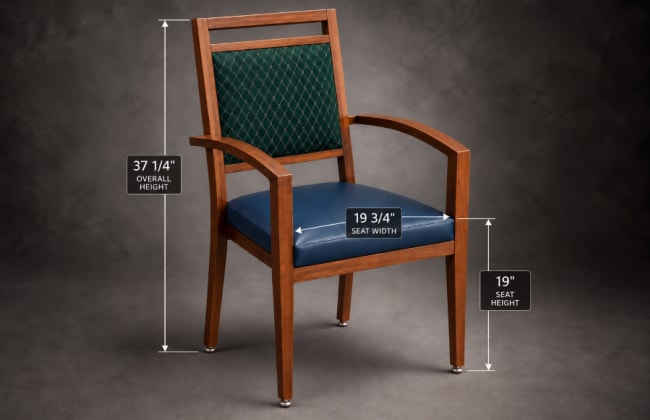
This becomes especially important when two specifications happen to use the same number. A 19 3/4" overall chair width and a 19 3/4" seat width are not equivalent measurements, even though the numbers match. Compare overall width with overall width, seat width with seat width and other corresponding dimensions before drawing conclusions about chair size or seating space.
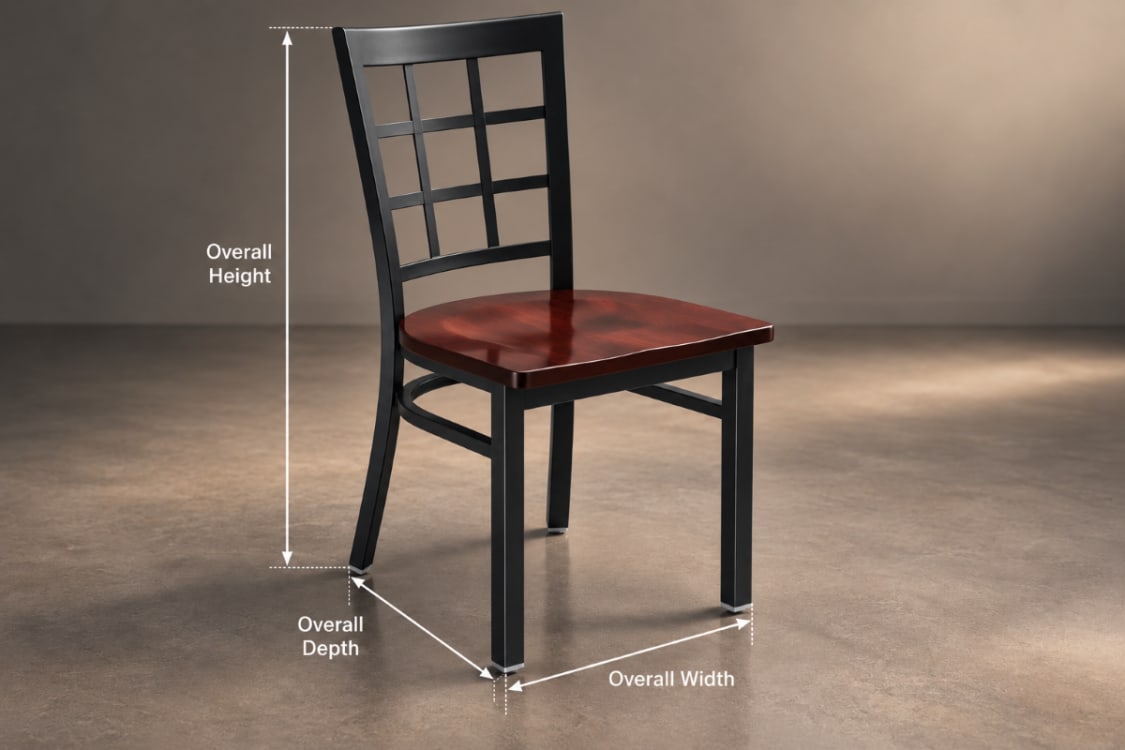
Overall Dimensions
How Much Room Does the Chair Occupy?
Overall width measures the chair from its widest exterior point on one side to the widest point on the other. Overall depth measures the full front-to-back footprint. These dimensions describe the space occupied by the complete chair rather than the usable seating surface, making them useful when comparing chair footprints and estimating how seating will fit around tables.
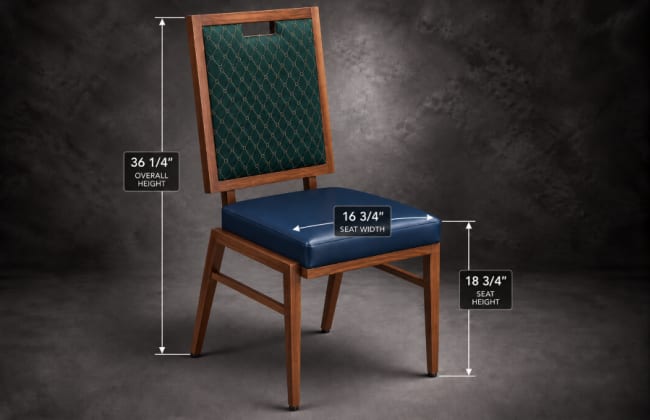
Overall height runs from the floor to the highest point of the chair. It helps describe the chair's full scale, but it should not be confused with seat height. A tall back can increase overall height without changing where the user sits, just as arms or a wide frame can increase overall width without increasing the usable width of the seat.
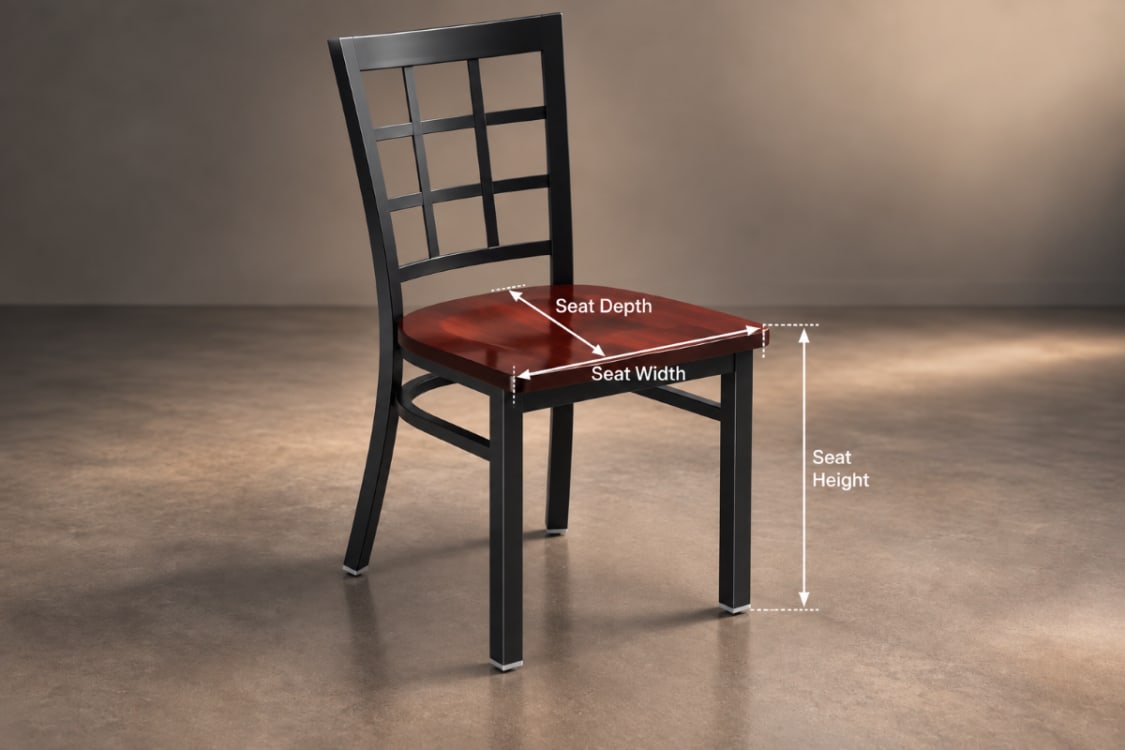
Seat Dimensions
How Much Seating Space Is Available?
Seat width measures the usable seating surface from side to side, while seat depth describes that surface from front to back. These measurements answer a different question from overall width and depth. Two chairs can occupy similar amounts of floor space while providing different seating dimensions because of the frame, arms, back construction or the relationship between the seat and surrounding structure.
Seat height measures from the floor to the seating surface and helps establish where the user sits in relation to the table. Compare it with the table height and the structures beneath the tabletop rather than treating it as another measure of the chair's overall size. Taken together, seat width, depth and height describe the seating position much more clearly than the chair's exterior dimensions alone.
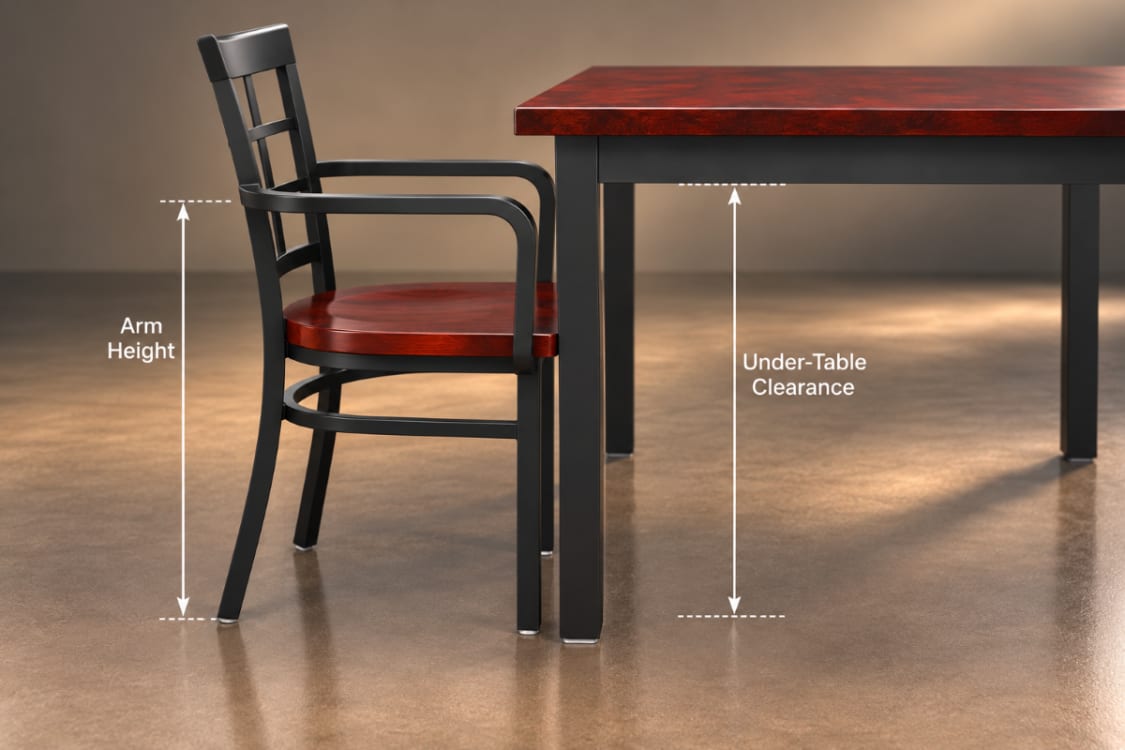
Arms and Table Clearance
Will the Chair Work With the Table?
Arm chairs add another measurement because neither overall width nor seat width tells you whether the chair can slide beneath a particular table. Arm height should be compared with the lowest obstruction under the table, which may be the underside of the tabletop, an apron, frame or another supporting structure. A tabletop can appear high enough while an apron below it prevents the arms from passing underneath.
That clearance affects how far the chair can move toward the table and how it occupies the surrounding floor space when in use. The chair also needs room to be pulled away so someone can sit down or stand up. Product dimensions provide the measurements needed to investigate table fit, but the chair and table specifications still have to be considered together.
Using the same measurement across models prevents an apparent size difference from being created by two different specifications. Overall dimensions describe the complete chair, seat dimensions describe the seating surface, and arm height introduces a separate relationship with the table.
Once those measurements are aligned, differences in chair weight, stacking capacity and other features become easier to interpret. The Cortona and Noveltra provide a useful next comparison because similar commercial construction leads to different seating dimensions, handling characteristics and storage capabilities.
Put Two Similar Chairs Side by Side
The Cortona Aluminum Arm Chair and Noveltra Aluminum Flex-Back Banquet Chair make a useful comparison because they begin with similar construction. Both use fully welded 12-gauge aluminum frames, upholstered seats and backs, integrated handholds and stackable construction. Both also have a listed 500 lb. weight capacity.
The differences emerge in the finished chairs. The Cortona provides an armchair seating position with different proportions and mobility options, while the Noveltra reduces chair weight and increases stacking capacity for repeated room changes.
More Emphasis on the Individual Seating Position
The Cortona is an arm chair with a 19 3/4" seat width and 18 1/4" seat depth. Its upholstered seat and back are combined with arms that provide a support point on either side of the user. The wider chair requires more space around the table while providing arms and more generous dimensions for repeated daily use.
The chair weighs 20 lb., includes an integrated handhold and stacks four high when seating needs to be temporarily removed. Optional casters provide another option for routine repositioning. These features give a facility some flexibility in moving and storing the chair without making frequent room resets the central purpose of the design.
More Emphasis on Movement, Setup and Storage
The Noveltra starts with similar aluminum and upholstered construction but makes different choices around it. The chair is armless, has a 16 3/4" seat width, 16 1/4" seat depth, and weighs 17 lb. That three-pound difference may have little consequence when someone moves a single chair, but banquet staff may repeat the same movement dozens or hundreds of times while setting or clearing a room.
Storage receives greater attention as well. The Noveltra stacks ten high, compared with four for the Cortona. Its integrated handhold provides a designated gripping point during repeated handling, while available ganging allows multiple chairs to be connected when a room is arranged in rows. The flex back adds movement at the backrest while a guest remains seated. Together, those features affect how the chair is used during an event, moved during a room reset and stored afterward.
What Changes When There Are 100 Chairs?
Scale makes these differences easier to appreciate. The Noveltra weighs three pounds less per chair. That difference applies each time a chair is lifted or carried during a room reset, so its practical importance depends on how often staff handle the inventory and how the chairs are transported.
Stacking makes the difference even more visible. At their listed stacking quantities, 100 Cortona chairs require 25 stacks, while 100 Noveltra chairs require 10. Actual storage planning still depends on stacked dimensions, transport equipment and available storage space, but reducing the inventory from 25 stacks to 10 changes the amount of separate material staff must handle and accommodate.
Commercial Chair Design in Practice
Specifications become more useful when they are viewed as part of a complete chair. Dimensions, construction and handling features work together, and the resulting product can be well suited to one type of daily use without needing every feature available elsewhere in commercial seating.
These three chairs provide very different examples. The restaurant model uses straightforward metal construction for everyday dining, the senior living armchair devotes more space and structure to the seating position, and the banquet chair combines upholstered seating with features intended for frequent room changes.
Metal Ladder Back Restaurant Chair
Restaurant Chair
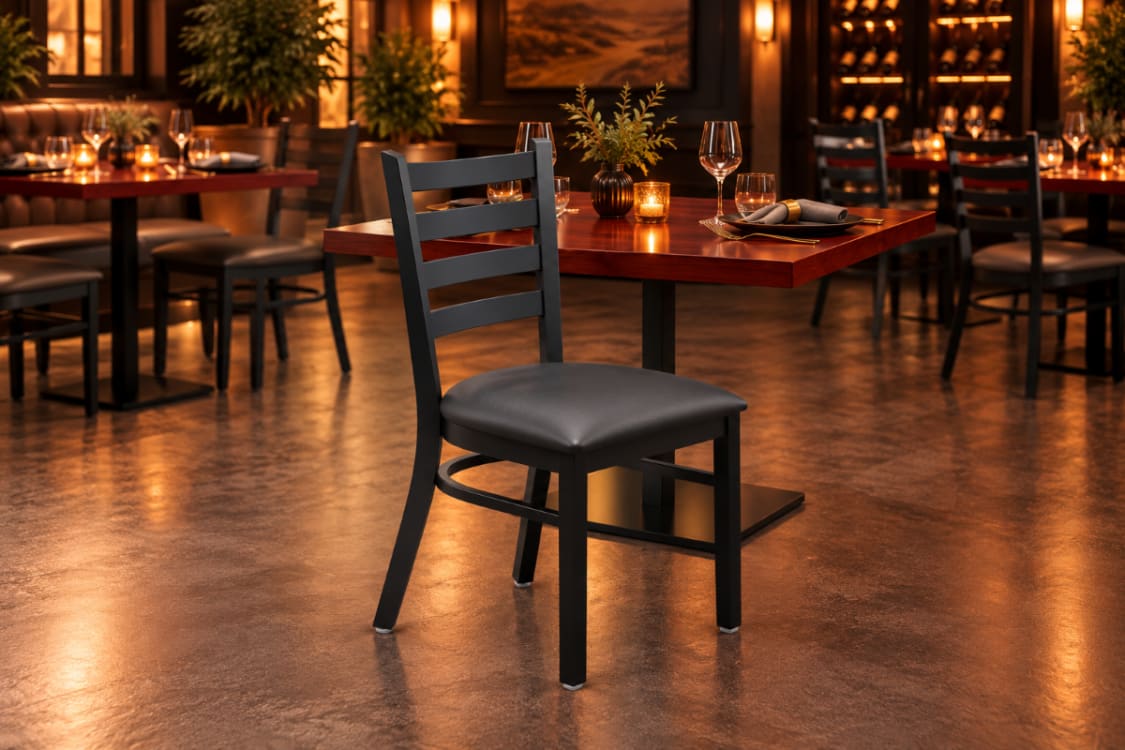
The Metal Ladder Back Restaurant Chair is a compact, armless model with a 17" overall chair width and commercial-grade metal frame. Continuous root welds reinforce stress points, while a baked powder coat protects the frame during indoor use.
At 15 lb., the chair is relatively easy to reposition around dining tables for service and cleaning. Its compact footprint can also help where table spacing is limited, although the actual fit still depends on the table dimensions and surrounding clearance. Buyers who regularly clear and store the entire chair inventory should compare its handling and storage characteristics with models designed for frequent room resets.
Ruthlan Aluminum Arm Chair
Senior Living Chair
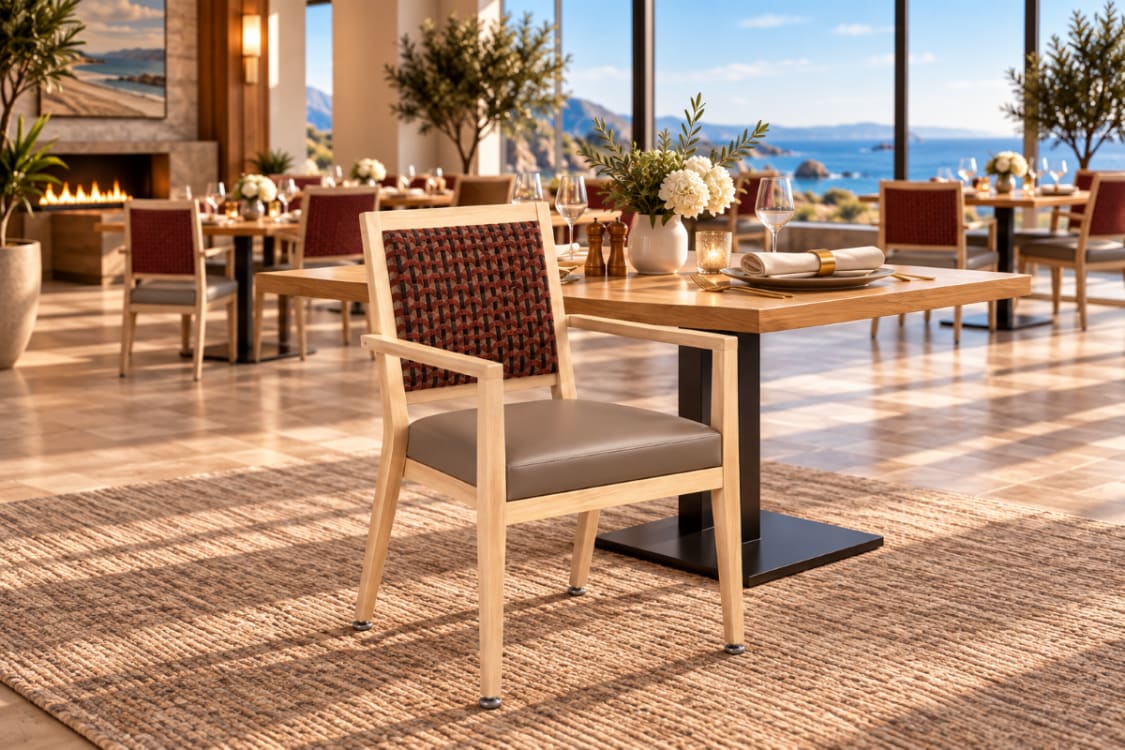
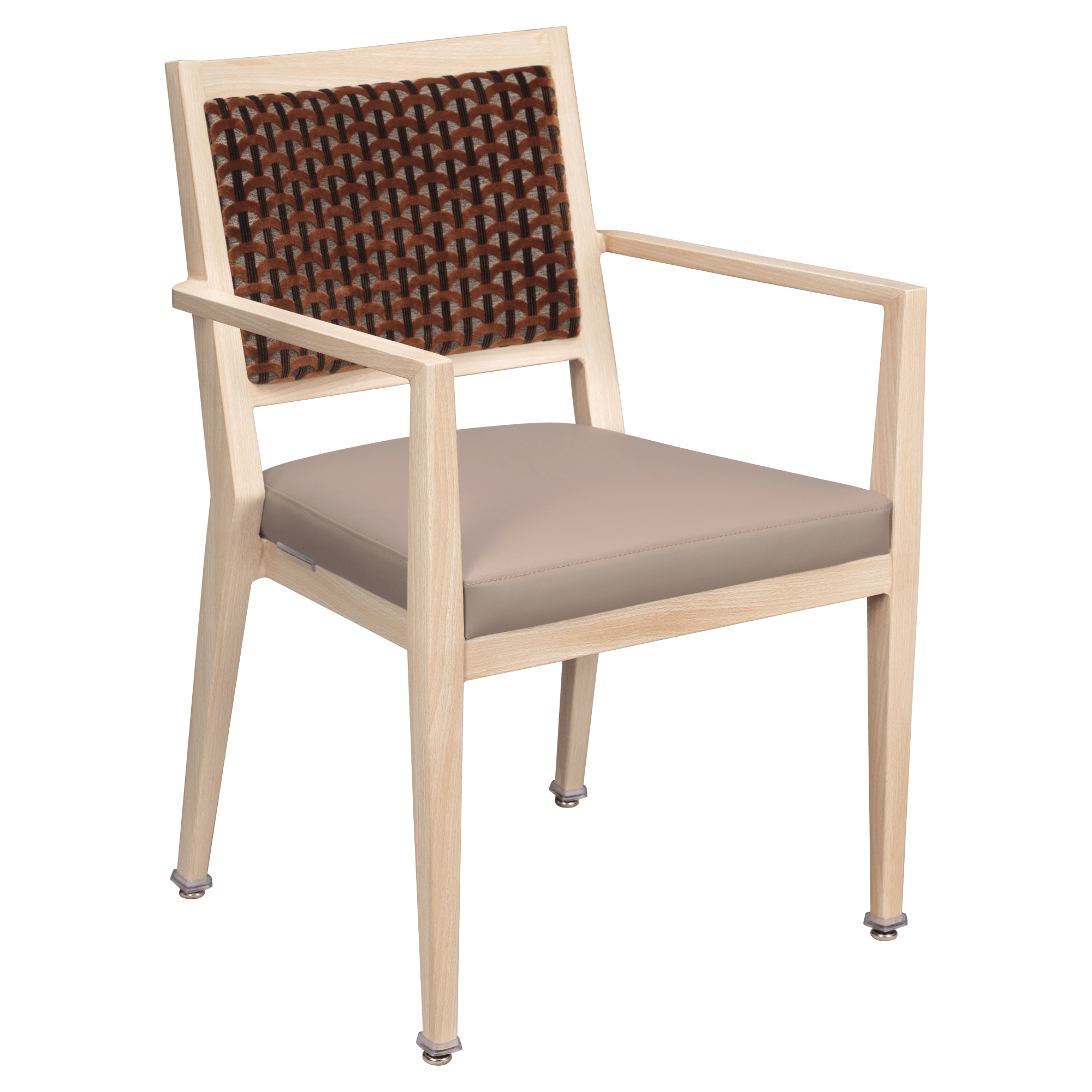
The Ruthlan Aluminum Arm Chair has a 19 3/4" overall width, with a 19 3/4" seat width and 18 3/4" seat depth. Its 2 3/8" thick high-density foam seat is paired with a padded back and contemporary arms. The fully welded aluminum frame uses tapered 12-gauge tubing, while extensive upholstery and frame-finish choices allow the commercial construction to take on a more residential dining appearance.
At 20 lb., the Ruthlan is heavier than the restaurant example, while its arms and available casters serve different daily needs. The arms require careful table-clearance checks, and stacking four high may be limiting where entire chair inventories are stored frequently.
Geraldine Flex Back Aluminum Stack Chair
Banquet Chair
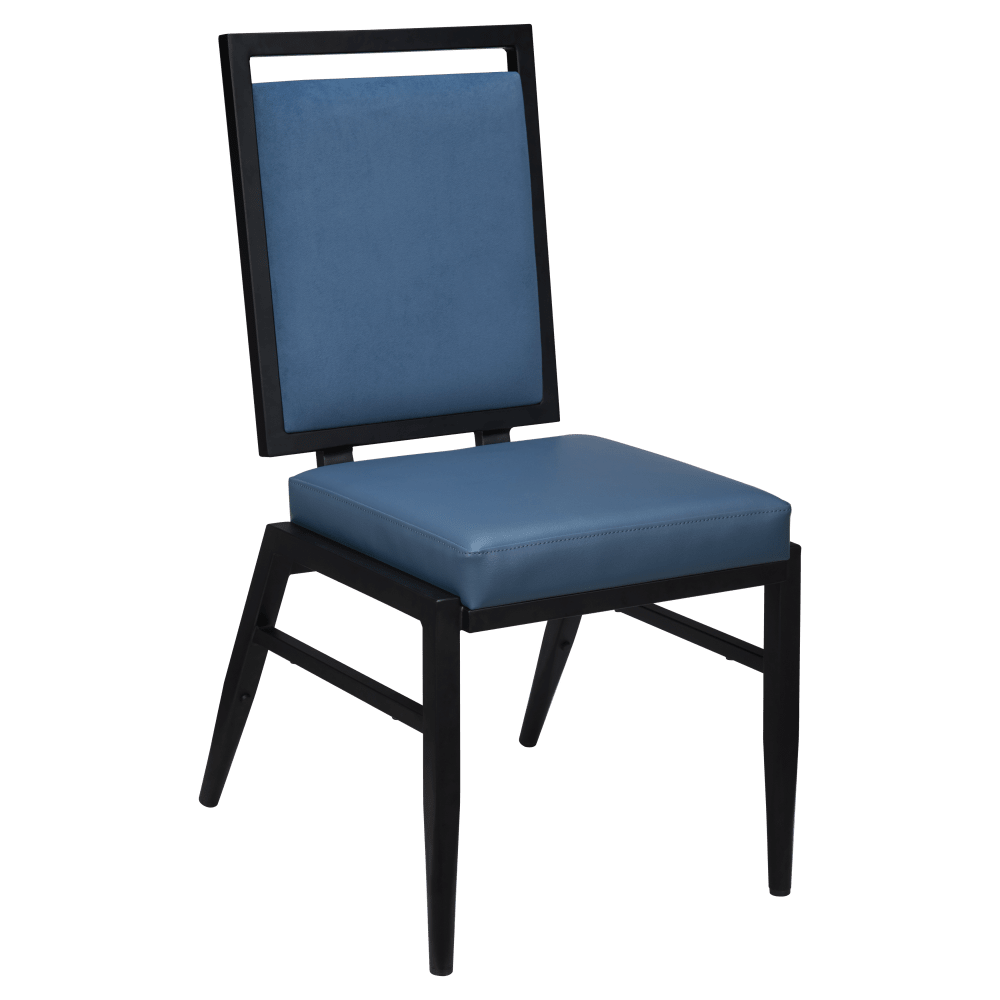
The Geraldine Flex Back Aluminum Stack Chair combines a fully welded 12-gauge aluminum frame with a padded back and a 3 1/4" thick molded foam seat. Its 18 3/4" overall width includes a 16 3/4" seat width, while flex-back construction allows movement through the back as a guest remains seated. Multiple frame finishes and upholstery choices give venues room to coordinate the chair with different event settings.
The more distinctive difference appears when the chair leaves the table. At 18 lb., the Geraldine stacks up to ten high and includes features suited to repeated setup, breakdown and storage. Buyers should still consider whether its seating dimensions suit the intended event, rather than allowing handling and storage advantages to drive the decision by themselves.
From Product Type to Facility Fit
None of these chairs needs to outperform the others across every specification. Their differences make sense in relation to the work they are expected to perform, including daily dining, resident use and repeated event-room changes.
A feature that adds considerable value in one facility may offer little benefit in another, and it may bring a tradeoff in footprint, weight or storage. The buying decision therefore starts with the tasks the chair will perform most often, which is where the final section turns next.
Which Chair Type Fits Your Facility?
Choosing between these chair types becomes easier when the facility's daily use comes first. How long chairs remain on the floor, who uses them and how frequently they are moved can quickly narrow the field.
Use the situations below as a starting point. More than one may apply, particularly in multipurpose dining and event spaces.
1
Restaurant Chairs
The Chairs Stay at Dining Tables Most of the Day
Daily dining service is the primary job, so the chair needs to work with the tables and surrounding floor plan through normal service, cleaning and seating adjustments.
-
Check chair width and overall table fit.
-
Compare frame construction for repeated daily use.
-
Select upholstery or seat materials with cleaning in mind.
-
Consider how the finish fits the dining environment.
2
Senior Living Chairs
Residents Use the Chairs for Daily Dining
Give closer attention to the seating position and the way residents and staff interact with the chair throughout the day.
-
Compare seat height, width and cushioning.
-
Check the arm configuration and arm height.
-
Consider chair weight and available handholds.
-
Review glide and caster options for routine repositioning.
3
Banquet Chairs
The Room Regularly Changes Between Uses
Frequent setups and breakdowns make movement, configuration and storage important parts of the buying decision.
-
Compare chair weight and stacking capacity.
-
Look for a practical handhold for repeated movement.
-
Consider flex-back construction where appropriate for the event setting.
-
Check ganging options and overall storage requirements.
4
Handling and Storage
Large Numbers of Chairs Go Into Storage
A chair that stacks is only the beginning. The number of chairs in each stack and the work required to move them become increasingly important as the inventory grows.
-
Check the maximum listed stacking quantity.
-
Compare individual chair weight.
-
Account for the footprint of the completed stacks.
-
Determine how stacks will be moved to and from storage.
5
Restaurant and Banquet Seating
One Room Has to Handle Dining and Events
The right balance depends on how frequently the room changes. Occasional rearrangement creates different demands than a space that goes through complete event resets several times a week.
-
Compare dining comfort and table compatibility.
-
Consider chair weight during complete room resets.
-
Check stacking capacity against available storage.
-
Match the chair to the actual frequency of layout changes.
6
Follow the Specifications
A Chair From Another Category Fits the Facility Better
A chair from another category may be a better fit if its dimensions, construction and features suit the facility's daily use.
-
Verify the complete chair and seat dimensions.
-
Compare construction with expected daily use.
-
Consider how often the chair will be moved or stored.
-
Check model-specific features rather than relying on the category name.
Before placing a larger order, compare the chair specifications with the conditions in the facility where it will be used. Check overall dimensions against the tables and available floor space, including arm and apron clearance where applicable. For stacking chairs, compare the listed stacking quantity with the available storage area and planned handling method.
Review the selected upholstery's cleaning instructions, along with chair weight, glides and other features that affect routine use. Verifying these details before ordering can identify conflicts that are easy to miss when individual specifications are considered separately.
Cleaning and Maintenance Are Part of the Buying Decision
Cleaning requirements should be considered before a chair reaches the facility. Food and drink spills are routine concerns in commercial dining, while senior living seating may also be exposed to accidents associated with resident care. The upholstery and chair construction can both affect the work required to keep seating in daily use.
Choose Upholstery for the Cleaning It Will Face
Fabric and Vinyl Need More Than a Visual Comparison
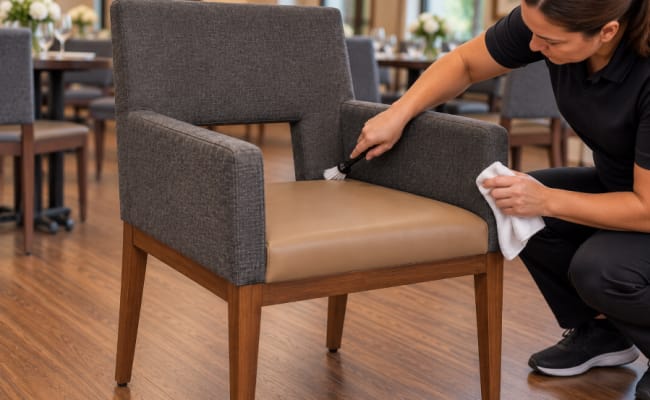
Senior living upholstery may face frequent food and beverage spills as well as accidents associated with incontinence. Many commercial chair fabrics are designed for demanding daily use, with options that provide stain resistance and easier routine cleaning. Vinyl provides another upholstery option for facilities where frequent wipe-down cleaning is expected.
Performance varies by material, including among different fabrics and vinyls. Review the care instructions for the specific upholstery selected, paying attention to approved cleaners and cleaning methods. The facility's normal procedures should be compared with those instructions before the upholstery is specified rather than after the chairs arrive.
Look Beyond the Upholstery
Chair Construction Affects Cleaning and Maintenance
Cleaning does not stop at the upholstered surface. Check the junctions between the seat, back and frame, along with upholstery seams and openings where food, liquids or debris may collect. The shape of the chair can determine how easily staff can reach these areas during routine cleaning.
Fully welded aluminum frames may use a durable wood-grain finish or powder coat, both designed to provide a lasting, scratch-resistant commercial surface. Routine maintenance is limited, but glides should still be checked for wear because damaged or worn glides can affect chair movement and the flooring beneath them.
Cleaning needs vary by facility, so the chair and upholstery should be matched to the conditions they will actually face. Review the selected upholstery's care instructions and consider how easily staff can reach seams, junctions and other areas where debris may collect.
With dimensions and cleaning requirements established, the next comparison looks at how similar commercial construction can produce chairs intended for very different types of daily use.
Conclusion: Buy for What the Chair Will Actually Do
The most useful chair specifications are the ones connected to tasks that happen repeatedly. Daily table service places different demands on seating than resident dining or frequent event resets, even when the chairs share materials and construction methods.
Start with the facility's normal routine, then use dimensions, construction and functional features to narrow the products that fit it. Affordable Seating's extensive catalog of commercial seating offers restaurant chairs, senior living seating and banquet chairs across a range of constructions, styles and feature sets, giving buyers a practical place to compare options once those priorities are clear.